The Big Buddha of Phuket
The island's landmark statue — how to visit, dress code, timing and the view.
Updated 2026-08-04
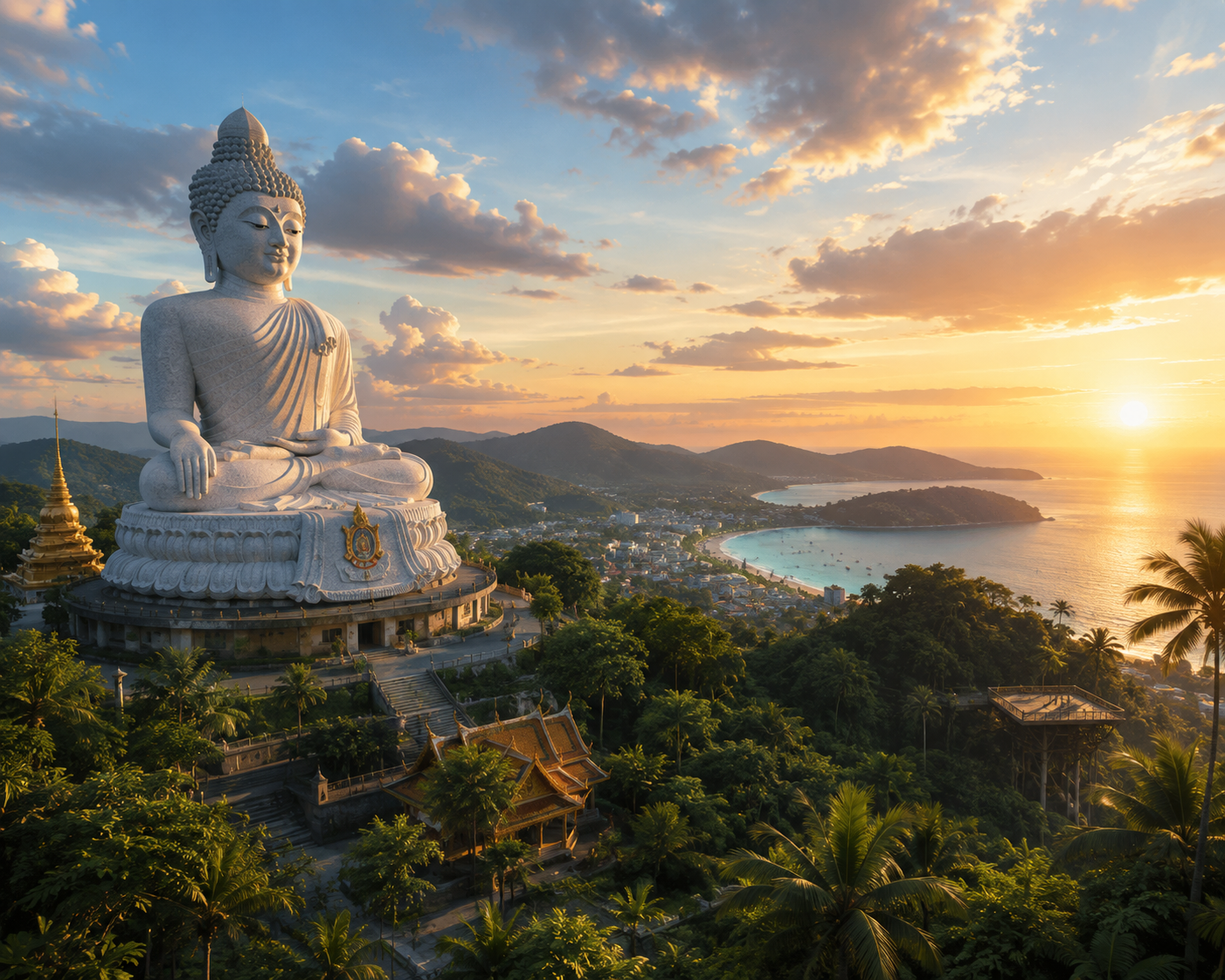
The Big Buddha of Phuket (Phra Phutthamingmongkol Akenakkiri) is a 45-metre white marble statue on Nakkerd Hill, roughly 400 m above sea level between Chalong, Kata and Karon. It is one of the island's most recognisable landmarks and a working Buddhist site funded by donations. Important: as of 2026 the hilltop complex has faced closures and restricted access following a fatal landslide in the surrounding Nakkerd Hills in August 2024, so confirm the current status before you travel.
Is the Big Buddha open right now?
The Big Buddha is not a demolished or permanently lost site — it is a functioning temple undergoing safety works on an unstable hillside. During restricted periods the summit platform, the ordination hall and the viewpoints may be off-limits even when the lower approach road is passable. Because Thai authorities reassess the slope after each heavy-rain spell, treat any 'open/closed' claim older than a few weeks as unreliable.
History and description of the Big Buddha
Construction of the statue began in 2004 and progressed almost entirely on public donations, which is why collection points and dedication plaques are woven through the site. The main image, formally named Phra Phutthamingmongkol Akenakkiri, is clad in white Burmese marble that turns luminous in strong sun. At roughly 45 metres tall and 25 metres wide at the base, it sits in the classic Maravijaya (subduing Mara) posture, right hand touching the earth.
A smaller golden Buddha cast in brass stands nearby, and the terraces hold bells, bodhi trees and shrines used for merit-making. Because the project is community-built rather than a ticketed attraction, the atmosphere is closer to a living monastery than a tourist stop — monks are present, and quiet respect is expected.
The grounds and atmosphere
The complex spreads across the summit with open marble terraces, a wooden ubosot (ordination hall), a hall displaying donor engravings, and small stalls selling drinks, sarongs and offerings. On calm mornings the wind carries the sound of temple bells, and the marble stays cool underfoot before midday. Long-tailed macaques sometimes appear along the access road and lower slopes; they are wild animals — do not feed or approach them, and keep sunglasses, phones and food out of sight.
Panoramic views and photo spots
On a clear day the summit gives a rare 360-degree view of southern Phuket: Chalong Bay and its yacht anchorage to the east, the curve of Kata and Karon beaches to the west, and Phuket Town spread out to the north. The best light is the golden hour before sunset for the western beaches, and just after opening for a haze-free eastward view over Chalong. When the summit is closed, the mid-slope pull-offs on the access road still offer good vantage points over the bay.
How to reach the Big Buddha
The turn-off is on Chalong's Chao Fah West Road, from where a winding 6 km sealed road climbs to the summit. Most visitors arrive by rented scooter, private car, taxi or a ride-hailing app such as Grab. The final climb is steep with tight bends, so it is not ideal for first-time scooter riders, especially after rain. Expect roughly 30–40 minutes by road from Patong or Kata and about 20–25 minutes from Chalong pier, traffic permitting.
If you are combining sights, the Big Buddha pairs naturally with Wat Chalong and the southern viewpoints on a half-day loop — the same corner of the island covered in our wider Phuket attractions guide. Travellers heading straight from the airport should budget around an hour to reach Chalong before the hill climb.
- 1Reach ChalongBase of the hill
Aim for Chalong Circle or Chalong Temple as your landmark; the Big Buddha road branches west from Chao Fah West Road.
- 2Climb the access road≈ 6 km
A single sealed road switchbacks to the top. Drive slowly; watch for oncoming traffic and monkeys on blind bends.
- 3Park and walk upFree parking
Park at the summit lot, then take the final stairs to the marble terrace and statue.
Visiting rules and etiquette
- Dress modestly: shoulders and knees must be covered. Free sarongs are usually lent at the entrance when the site is open.
- Remove shoes and hats before entering the ordination hall and interior shrines.
- Keep your voice low and do not turn your back directly to the Buddha image when taking photos.
- Do not feed the macaques; secure loose items and food.
- There is no entry fee, but a donation supports ongoing construction and upkeep.
Best time to visit
The dry season from November to April offers the clearest panoramas and the safest hill road. Within the day, arrive by 07:30–09:00 to beat both the heat and the tour-bus crowds, or come in the last hour before sunset for warm light over Kata and Karon. Avoid visiting during or right after heavy monsoon rain (May–October): the marble becomes slippery, views vanish into cloud, and — given the 2024 landslide — the slope is at its most sensitive.
Alternatives if the Big Buddha is closed
If the hilltop is off-limits, several nearby sites deliver similar culture-and-view experiences. Wat Chalong, Phuket's largest and most important temple, sits just downhill and is open year-round. For the coastal panorama, the Karon Viewpoint (Three Beaches Viewpoint) and Windmill Viewpoint near Nai Harn cover the same southern coastline. Promthep Cape at the island's southern tip is the classic sunset spot. These pair well with the transport tips in our airport and Patong travel guides.