Phuket Attractions: What's Worth Seeing
The sights that earn their place on your itinerary, ranked by what they deliver.
Updated 2026-08-04
Phuket, Thailand's largest island in the Andaman Sea, is more than its beaches. Its attractions cluster into a few groups: cultural landmarks like Wat Chalong and the Sino-Portuguese Old Town; nature such as Sirinat National Park and Bang Pae Waterfall; viewpoints like Promthep Cape and Karon Viewpoint; and markets led by the Naka Weekend Market. Rent a scooter or use a ride-hailing app, plan around west-coast beaches plus one culture-and-viewpoint loop, and visit in the dry season (November–April) for calm seas and clear skies.
Getting around Phuket on your own
Phuket is big — about 50 km top to bottom — so how you move shapes what you can see. Four options cover almost every traveller. A rented scooter gives the most freedom and is how many independent visitors explore, but the island's traffic and hilly coastal roads punish inexperience. A rented car is safer for families and rainy days. Ride-hailing apps such as Grab and inDrive show a fixed price up front, with no haggling. The Phuket Smart Bus runs the west coast from the airport down to Rawai for budget hops between beaches.
A simple rule that saves money and stress: use apps for evenings and airport runs, and rent wheels only if you are confident and plan to roam widely. Distances look short on a map, but the winding roads over the headlands take longer than you expect, especially in high season.
Renting a scooter or car on Phuket
Rent from a shop that photographs the vehicle with you and gives a written condition check — film any existing scratches yourself before riding off, as damage disputes are the classic tourist trap. A helmet is legally required and roadside police do fine riders without one. To drive legally you need an International Driving Permit with the correct category alongside your home licence; travel insurance often will not pay out for a scooter accident if you were riding without the right permit.
Routes for self-guided day trips
Three logical loops make planning easy. First, a central culture day: Old Phuket Town plus the Thalang road temples, best on foot once parked. Second, a west-coast beach run: Patong, Karon and Kata strung along the coast road, with a viewpoint stop between them. Third, a southern viewpoints loop: Promthep Cape, the Windmill Viewpoint and Nai Harn, ideally timed to finish at sunset. Keep each loop to one region a day and you will spend time seeing, not driving.
Top 10 attractions in Phuket
If you only have a few days, these ten places capture the island's range — beach, culture, nature and view. The sections below expand on the natural, cultural and market highlights; think of this as the shortlist.
- Old Phuket Town — Sino-Portuguese streets, cafés and street art; best in the late afternoon.
- Wat Chalong — Phuket's grandest working temple; go early and dress modestly.
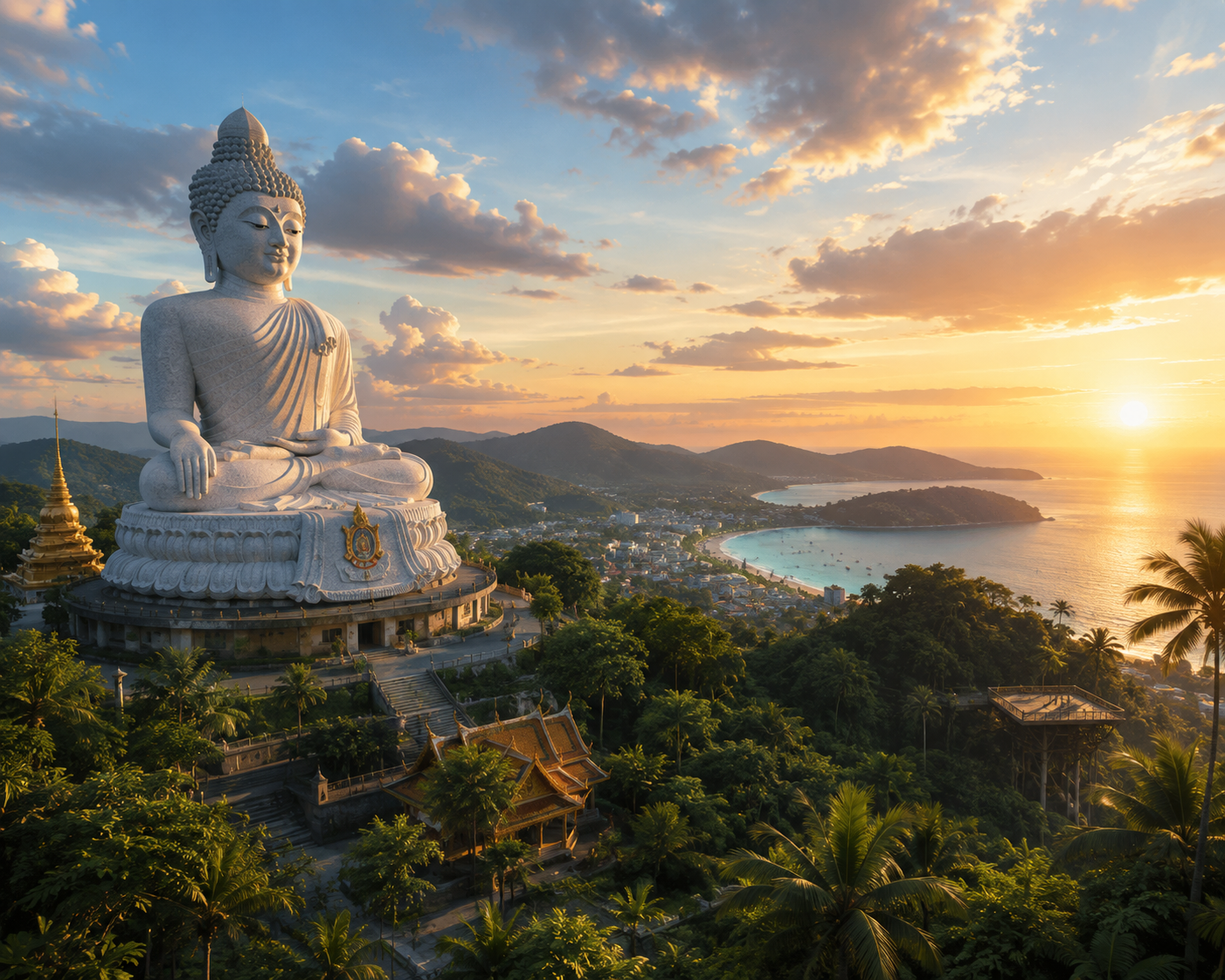
- Big Buddha (Nakkerd Hill) — landmark statue with island-wide views; check its current access status before going.
- Promthep Cape — the island's classic sunset headland at the southern tip.
- Kata and Karon beaches — the balanced west-coast pair for swimming and sunset.
- Nai Harn Beach — a calmer, scenic bay in the south backed by a lagoon.
- Sirinat National Park (Mai Khao) — quiet beaches, casuarina forest and mangroves in the north.
- Bang Pae Waterfall — jungle waterfall in Khao Phra Thaeo, best after rain.
- Naka Weekend Market — the biggest night-market feast for food and browsing.
- Karon Viewpoint — the sweeping 'three beaches' panorama over Kata Noi, Kata and Karon.
Natural attractions of Phuket
Beyond the sand, Phuket keeps pockets of wilderness: protected coastline, rainforest and waterfalls that most beach-only visitors miss. A morning inland is cooler, greener and quieter than a crowded shore. If you have a scooter or car, the north and east of the island reward a half-day of exploring.
Phuket's beaches and how they differ
The west coast holds the famous sand, and it helps to sort beaches by mood. Lively: Patong, the entertainment hub, busy day and night. Family-friendly: Karon and Kata, wide and easy with gentle facilities. Quieter escapes: Nai Harn in the south and Mai Khao in the north, where the crowds thin and nature returns. Match the beach to your day, and remember that during the May–October monsoon strong currents and red-flag warnings are common on the west coast — never swim past a red flag.
Sirinat National Park
In Phuket's northwest, Sirinat National Park protects the long, undeveloped beaches around Mai Khao and Nai Yang, plus casuarina forest and a mangrove nature trail. It is loved for its calm and its sea-turtle nesting season in the cooler months. Come on a weekday morning to have the sand almost to yourself; there is a national-park entry fee, so bring cash, and pack water, sun protection and insect repellent for the shade.
Bang Pae Waterfall
Bang Pae Waterfall sits inside the Khao Phra Thaeo forest reserve in the northeast, the island's largest patch of virgin rainforest. It flows strongest in and just after the rainy season and can slow to a trickle in the dry months. A short jungle trail leads to the falls, where you can sometimes cool off in the pool depending on the water level. Wear grippy shoes, bring repellent, and check conditions before wading after heavy rain.
Cultural and historical sights
Phuket's culture is a blend of Thai, Chinese and European influence, a legacy of its tin-mining boom when Hokkien Chinese merchants and Western traders shaped the island. Two experiences capture it best: the island's most revered temple, and the pastel streets of the old town. Both are easy to combine in a central day out.
Wat Chalong and its relics
Wat Chalong is Phuket's largest and most important Buddhist temple, dedicated to two revered monks, Luang Pho Chaem and Luang Pho Chuang, who helped islanders during the 19th-century tin-miner uprising. Its centrepiece is the Grand Pagoda (Phra Mahathat Chedi), which enshrines a relic said to be a splinter of bone of the Buddha; the upper levels give a view over the temple grounds. Dress code is enforced — cover shoulders and knees, remove your shoes indoors, and keep quiet inside the halls. Early morning is coolest and least crowded.
Old Phuket Town
Old Phuket Town is a grid of Sino-Portuguese shophouses in faded pastels, now filled with cafés, galleries and street art. A 60–90 minute walk along Thalang, Dibuk and Soi Romanee takes in the best facades — go late afternoon when the light softens and the heat eases. Duck into a coffee shop or a local dessert spot, and look up: the decorative upper stories tell the town's mixed-heritage story.
Markets and shopping in Phuket
Markets are where Phuket eats and socialises, and they are the best-value way to try Thai street food. Come hungry and graze: grilled seafood, pad thai, mango sticky rice, fresh juices and fried snacks cost a fraction of restaurant prices. For souvenirs — printed clothing, handicrafts, soaps and trinkets — gentle bargaining is expected: ask the price, offer a bit less with a smile, and settle somewhere in between. Prices at fixed-price food stalls, though, are not for haggling.
- Do buy: street food, fresh fruit, local snacks, printed tees and handicrafts.
- Do bargain: on clothing, souvenirs and non-food goods — politely, and only if you intend to buy.
- Avoid: haggling over cheap street food, and impulse-buying anything you would not carry home.
Naka Weekend Market
The Naka Weekend Market, near Phuket Town, is the island's biggest night market and runs on weekend evenings. It is a sprawl of food stalls, clothing, second-hand finds and household oddities, packed with locals as well as visitors. Arrive early in the evening before the crowds thicken and the best food sells out, bring small cash, and treat the low sticker prices as a starting point for a friendly bit of bargaining on non-food items.
Best time to visit Phuket
Phuket has two clear seasons. The dry, high season runs roughly November to April: calm Andaman seas, sunny days and the best conditions for beaches, viewpoints and boat trips — but higher prices and bigger crowds. The green, low season runs May to October, with warm rain that often falls in short bursts, cheaper rates, and rougher west-coast surf that limits swimming. There is also a shoulder feel at each edge of these windows.
High and low season trade-offs
High season pros: reliable sun, safe swimming, all boat trips running, buzzing atmosphere. High season cons: crowds, higher prices, book ahead. Low season pros: lower rates, green landscapes, fewer people. Low season cons: rain, choppy west-coast seas, some island tours pause. Whichever you pick, plan the outdoor sights — viewpoints, waterfalls, boat days — for the mornings, when skies are clearest year-round.
Expert tips and recommendations
A few habits make a Phuket trip smoother, grouped into money, safety and comfort.
- Money: carry some cash for markets, temples and small stalls; use ride-hailing apps to avoid fare haggling; withdraw larger sums at once to limit ATM fees.
- Money: agree any tour or taxi price before you set off, and photograph your rental vehicle before riding.
- Safety: always wear a helmet on a scooter and carry the right driving permit; never swim past a red flag on the west coast in monsoon season.
- Safety: don't feed the wild monkeys near hilltop sites, and keep valuables out of sight.
- Comfort: start outdoor sights early to beat heat and crowds; carry water, sunscreen and repellent everywhere.
- Comfort: keep temple-appropriate clothing (covering shoulders and knees) in your day bag for spontaneous visits.
Safety and etiquette
- Dress modestly and remove shoes at temples; never touch or climb on Buddha images.
- Show respect for images of the Thai monarchy — it is taken seriously by law.
- On the roads, ride defensively and to the left; traffic is heavier than it looks.
- In the sea, respect flag warnings and rip-current signs, especially May–October.
- Never feed or provoke wild macaques near viewpoints and hilltop temples.
- Keep your voice down and turn phones to silent inside temple halls.
Getting to Phuket and to each sight
Nearly everyone arrives through Phuket International Airport in the north of the island; from there it is around an hour to the main west-coast beaches. For the specifics of transfers — official taxis, minibuses, the Smart Bus and how long it takes to reach Patong — see our airport-to-Patong guide and the full Phuket airport guide. If you are coming from the capital, our Bangkok-to-Phuket article compares flying, bus, train and driving. Once on the island, the loops above tie the attractions together with the least time behind the wheel.