Thailand DTV Visa: The Complete Guide
What the Destination Thailand Visa is, who qualifies, the money you need to show and how to apply — the long-stay route for remote workers and soft-power travellers.
Updated 2026-08-05
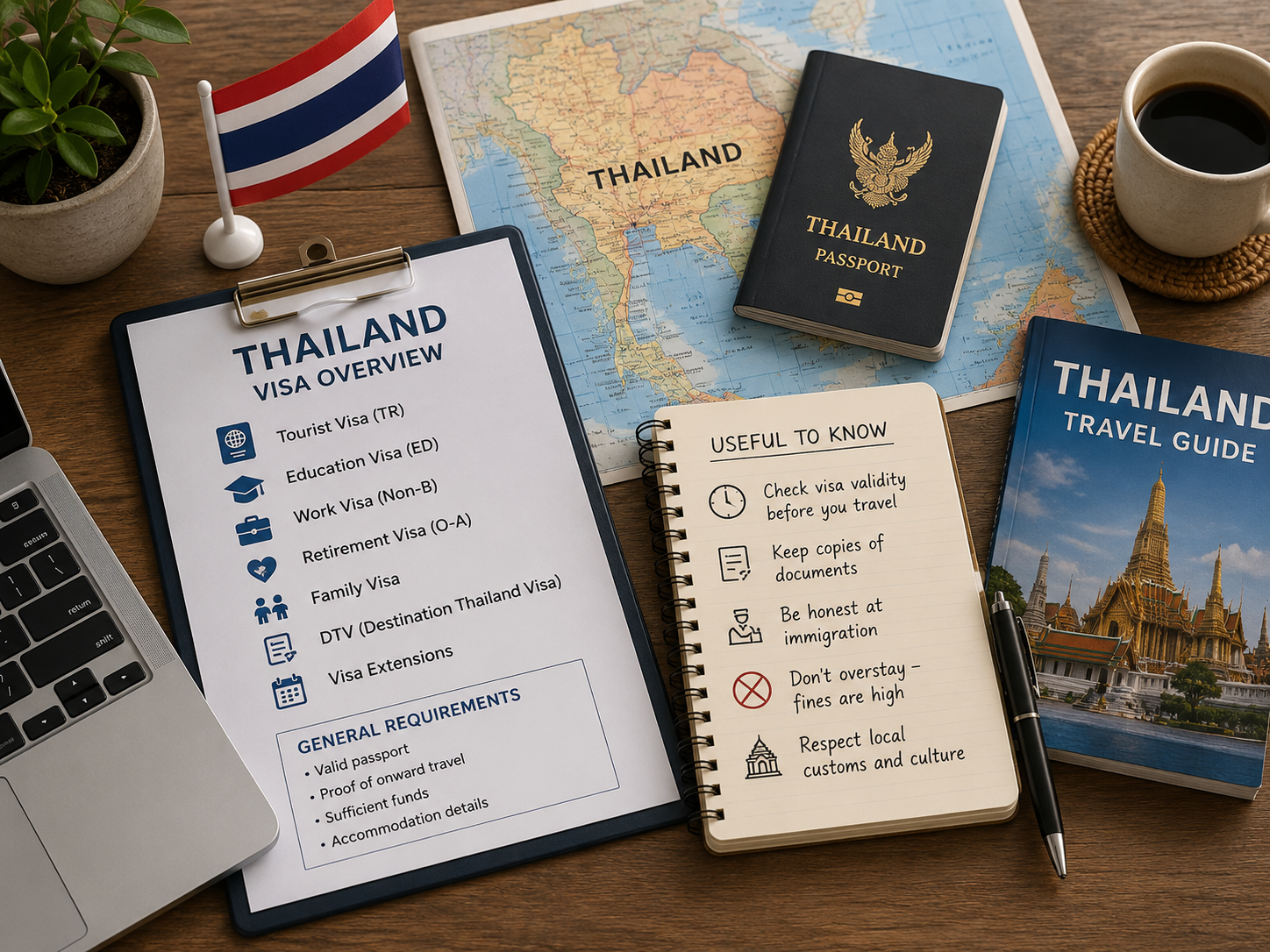
The Destination Thailand Visa (DTV) is the visa I point most remote workers and long-stayers at: a five-year, multiple-entry visa that lets you live here up to 180 days at a time, then extend once for another 180. It is not a work permit — it is for income earned outside Thailand, or for soft-power activities like Muay Thai or a cooking course. You apply from outside Thailand, show 500,000 THB you have actually held for a few months, and pay roughly 10,000 THB. That is the whole shape of it.
If you want to base yourself in Thailand for a real stretch without doing tourist-visa border runs every couple of months, the DTV is almost certainly the visa you have been looking for. It launched in 2024 and it is aimed squarely at remote workers, digital nomads, and people coming here to train, cook, get treatment, or study a Thai craft. I have watched a lot of people apply for it now, and the pattern of what works and what gets refused is pretty clear. Here is everything I would tell a friend before they start.
The DTV in six lines
- Validity: 5 years, multiple entry.
- Stay per entry: 180 days, extendable once for another 180.
- Cost: around 10,000 THB (roughly 275-400 USD depending on the embassy).
- Financial requirement: 500,000 THB in liquid assets, and you need to have held it for about three months.
- Who it's for: remote workers, Thai soft-power participants, and dependents.
- Where you apply: from outside Thailand only, via thaievisa.go.th or a Royal Thai Embassy/Consulate.
What the DTV actually is
DTV and 'Destination Thailand Visa' are the same thing — don't let the two names throw you. It was announced in the Thai Government Gazette on 15 July 2024 and it is live and running as of 2026. Here is the bit that trips people up: on paper it is a special tourist visa, not a work visa, and it does not come with a Thai work permit. What it does do is let you legally work remotely for employers or clients outside Thailand while you are here. So it is a tourist classification doing a digital-nomad job — a genuine step up from stitching together tourist entries the way people used to.
The core specs, in one place
This is how the DTV works in practice as of 2026:
- Visa type: special tourist visa (not a work permit).
- Validity: 5 years from issue.
- Entry type: multiple entry.
- Maximum stay per entry: 180 days.
- Extension: once, for another 180 days, so up to roughly 360 continuous days if you extend.
- Extension fee: 1,900 THB.
- Financial proof: 500,000 THB in liquid assets.
- Visa fee: around 10,000 THB (varies by country).
- Work rights: remote work for foreign employers only — no Thai work permit under this visa.
- Family: you can include a legal spouse and children under 20.
- 90-day reporting: required if you stay continuously past 90 days.
- Where you apply: outside Thailand only.
What it costs
The base government fee is 10,000 THB, but what you actually pay depends on where you apply. US applicants, for example, pay 400 USD (about 13,450 THB) as confirmed by the Royal Thai Embassy in Washington D.C. One thing to be very clear about: the fee is non-refundable whatever the outcome, so if you get refused, that money is gone. Fees vary by country, so check with your specific embassy before you pay.
Is this the right visa for you?
Treat this as a quick self-check. There are three official DTV categories, and you need to fit one of them:
- Workcation: remote workers, digital nomads, and freelancers earning from foreign-source income. This is the big one.
- Thai Soft Power: people joining recognised Thai cultural activities run by registered institutions — think Muay Thai, cooking, sports, medical treatment. Programmes generally need to be at least six months.
- Dependents: legal spouses and unmarried children under 20 of a main holder.
If none of those fits you cleanly — say you want to actually work for a Thai company, or retire here — the DTV is the wrong door, and something like an LTR or a retirement visa will serve you better.
The baseline requirements everyone must meet
Whichever category you fall into, these six are non-negotiable:
- Age: 20 or over.
- Location: you apply from outside Thailand.
- Immigration history: clean, no overstays or flags.
- Criminal record: clean.
- Financial proof: 500,000 THB in liquid assets, evidenced by 3-6 months of consistent bank statements.
- Passport: valid for at least 6 months (not 18 — that myth goes around a lot).
The full 2026 document checklist
Exactly which documents you need depends on your category, but everyone submits the same core set first. Here is the mistake I see most: people upload a phone screenshot of their banking app. Official guidance does not accept mobile screenshots or photos of screens — you need a proper, stamped or digitally-certified bank statement. Get that right and you have avoided one of the top refusal reasons.
- Valid passport (6+ months validity).
- A passport photo.
- Proof of residence outside Thailand (driver's licence, utility bill, residence permit, or a visa stamp all work).
- Official bank statement showing the 500,000 THB equivalent, held for 3-6 months — no mobile screenshots.
- Visa fee payment.
Workcation: remote workers and freelancers
On top of the core set, Workcation applicants add documents depending on how they earn:
- Employees: employment contract or Certificate of Employment, an employer letter confirming remote work and your salary, and payslips.
- Business owners: Certificate of Incorporation and a corporate tax return.
- Freelancers: a professional portfolio, client contracts, invoices, and bank statements showing the foreign-source income landing.
Freelancers, a warning from experience: you get the most scrutiny, especially if your income looks irregular or informal. English-language documents are the norm, but exact translation rules vary by consulate — check with the embassy you are applying through.
Thai Soft Power: cultural and activity-based visitors
Qualifying activities include Muay Thai, Thai cooking and cuisine courses, sports training, medical treatment, arts and music, and education or seminars. From the host institution you will need proof they are legitimate — their business registration or operating licence. Medical-treatment applicants need a treatment plan from a registered Thai facility, and programmes are generally expected to run at least six months.
Dependents: spouses and children under 20
- Spouses: an authenticated marriage certificate with English translation, a copy of the main holder's visa, and your passport.
- Children under 20: an authenticated birth certificate with English translation showing both parents' names, a copy of the main holder's visa, and the child's passport.
- Special cases: a minor travelling without one parent needs an original notarised consent letter from both parents or guardians. Non-US citizens applying at a US embassy also need proof of legal US residency — a Permanent Resident Card or a US visa valid 6+ months.
The word that does the damage here is 'authenticated'. People treat it as a formality, skip it, and then lose weeks. Get your marriage and birth certificates properly authenticated and translated before you file.
The 500,000 THB rule, decoded
This is where most applications live or die, so let me be specific about what counts. The two lists below are the whole game.
On the statements themselves: they need to cover 3-6 months and be issued recently — within roughly the last 7-30 days. And here is the single most-flagged financial issue: a sudden large deposit within 60-90 days of applying. If half a million baht magically appears the week before you file, that reads as borrowed money, not a stable balance. Season the account well ahead of time.
How to apply, step by step
There are two routes: the Thai e-Visa portal (thaievisa.go.th) and in-person at a Royal Thai Embassy or Consulate. Here is the sequence either way.
- 1Confirm you're outside ThailandStep 1
You cannot apply from inside the country — this alone gets applications binned.
- 2Check your category and eligibilityStep 2
Workcation, Soft Power, or Dependent, plus the six baseline requirements.
- 3Gather your documentsStep 3
The core set plus your category-specific documents, properly formatted.
- 4Choose your routeStep 4
e-Visa portal or in-person at an embassy/consulate.
- 5Complete the applicationStep 5
Fill in the forms and upload documents (or submit them in person).
- 6Pay the feeStep 6
Around 10,000 THB, and remember it is non-refundable whatever happens.
- 7Wait for processingStep 7
Roughly 5-15 working days via e-Visa; 14-28 days in person.
- 8Receive your DTVStep 8
Approval comes back, and you are set for five years.
Applying in person at a Royal Thai Embassy or Consulate
If you go the in-person route in the US, the primary point is the Royal Thai Embassy Washington D.C. Consular Office at 2300 Kalorama Road, N.W., Washington D.C. 20008, open Monday to Friday, 09:00-17:00, and it accepts mail applications at the Consular Section address. Whichever country you are in, you must apply from your country of legal residence — and verify your specific consulate handles the DTV before you show up.
What you can and cannot do on a DTV
The 180-day tax trap nobody mentions
This is the part I wish more people understood before they committed. Tax residency is about physical presence, full stop — the DTV does not shield you from it. Once you are a tax resident, foreign-sourced income remitted into Thailand is taxable if it was earned from 1 January 2024 onward and brought in during the same calendar year (income earned before that date is not taxed when you remit it). Thai income tax is progressive, up to 35% for 2026. Thailand does hold Double Tax Agreements with many countries, and the LTR visa can be a better fit tax-wise for some — but I would not guess at your country's DTA status. Talk to a qualified Thai tax advisor before you cross that first 180-day line.
What this looks like in real life
- Remote software developer, Germany to Chiang Mai: applies Workcation on an employer letter and payslips, bases himself in the north.
- Freelance graphic designer, US to Phuket: Workcation, carried by documented foreign client income and clean invoices.
- Muay Thai and cooking enthusiast, UK to Bangkok: Soft Power, on a six-month programme from a registered institution.
- Long-term medical patient, Australia to Bangkok: Soft Power, backed by a treatment plan from a registered Thai hospital.
- Couple with two kids, Canada to Koh Samui: one primary holder plus three dependents on the same application.
- Digital nomad, EU to Bangkok: takes the DTV first, then weighs up the LTR once settled.
DTV vs LTR vs Thailand Privilege
If you are weighing the long-stay options, here is how they line up in 2026.
Short version: the DTV is the value pick for remote workers and freelancers, Thailand Privilege suits people who want premium VIP treatment and will pay for it, and the LTR is aimed at higher-income professionals who need stronger work rights or tax perks.
Why DTVs get refused (and how to dodge it)
Almost every rejection I have seen falls into one of these seven buckets:
- Weak financial proof — crypto, sudden deposits, or non-liquid assets. This is roughly 40% of all denials on its own.
- Thin employment documentation, especially for freelancers with informal-looking income.
- Picking the wrong applicant category.
- Applying from inside Thailand (an automatic no).
- A non-qualifying soft-power provider — an unregistered institution, or a now-excluded Thai language school.
- Submitting screenshots or phone photos of screens instead of proper documents.
- A passport with under 6 months of validity.
Notice the theme: nearly all of it is documentation. Complete, correctly-formatted, well-seasoned paperwork is by far the most effective thing you can do to get approved.
So, is the DTV right for you?
If you earn your income remotely from outside Thailand, you have 500,000 THB you have genuinely held for three to six months, and your immigration record is clean, the DTV is a strong, well-priced choice and I would go for it. If you need real Thai work rights or tax incentives, look at the LTR instead (and confirm the current specifics with the BOI). If you just want premium VIP service and money is not the constraint, Thailand Privilege starts at 650,000 THB. Whichever way you lean, the two things that decide the outcome of almost every application are the same: audit your financial documents and confirm you are applying in the correct category. Nail those and the rest tends to follow.
Sources: Thai Ministry of Foreign Affairs / Thai e-Visa (thaievisa.go.th); Royal Thai Embassy and Consulates; Thailand Immigration Bureau; Tourism Authority of Thailand (TAT); Board of Investment (BOI); Thai Revenue Department. Fees, dates, and rules can change — confirm the current details with the relevant authority before you apply.