Best Resorts and Islands in Thailand
From the Andaman to the Gulf: the islands worth your holiday and what sets each apart.
Updated 2026-08-04

Thailand's best-known resorts and islands each suit a different traveller: Phuket for full-service beaches and nightlife, Koh Samui for a laid-back tropical-island feel, Krabi for dramatic limestone scenery and Railay's cliffs, and Pattaya for a lively, easy trip close to Bangkok. Which is best depends on your priorities and, crucially, the season — the Andaman side (Phuket, Krabi) peaks November–April, while the Gulf island of Samui runs on a slightly different weather calendar.
Why choose a beach holiday in Thailand
Thailand packs an unusual amount of variety into one country: warm 28–30°C seas most of the year, hundreds of islands across two coasts, excellent food, and prices that stretch a budget further than most tropical rivals. You can find a beach for almost any style — buzzing and built-up, family-friendly, or barefoot and remote — and move between resorts easily thanks to a dense network of domestic flights, ferries and buses. That range is exactly why choosing the right resort matters, and why the four below cover most travellers.
Top resorts and islands of Thailand
Four destinations dominate Thai beach tourism, split across the Andaman Sea and the Gulf of Thailand. Here is what each does best.
Phuket — the all-rounder
Phuket is Thailand's largest island and its most developed resort, on the Andaman coast. It has the widest choice of beaches on a single island — from lively Patong to family-friendly Kata and Karon and quiet Nai Harn — plus the fullest infrastructure: its own international airport, hospitals, malls and every level of hotel. It is the easiest place to combine beach days, nightlife, island-hopping to Phi Phi, and sights like the Big Buddha and Phuket Old Town. Choose Phuket if you want everything in one place.
Koh Samui — the tropical-island escape
Koh Samui, in the Gulf off Surat Thani, has a more relaxed, palm-fringed island atmosphere. Chaweng is its liveliest beach and Lamai its calmer sibling, while landmarks like the Big Buddha and the ornate Wat Plai Laem temple give the island its character. Samui has its own airport and is the gateway to the Ang Thong Marine Park and the party island of Koh Phangan. Its weather calendar differs from the Andaman coast, which can make it a smart alternative when Phuket is wet.
Krabi — the scenery star
Krabi, on the mainland Andaman coast near Phuket, is all about dramatic landscape: towering limestone karsts rising straight from turquoise water, the cliff-backed Railay peninsula reachable only by boat, and easy access to the Phi Phi and Hong islands. Ao Nang is the main beach town and base. Krabi is quieter and more nature-focused than Phuket, and a favourite for kayaking, rock climbing and island tours. Many travellers pair Krabi and Phuket in one Andaman trip.
Pattaya — the easy city-beach break
Pattaya, on the Gulf coast about two hours from Bangkok, is the most accessible resort and famous for its nightlife along Walking Street. The city beach is average, but nearby Jomtien and the offshore Koh Larn (Coral Island) offer better swimming, and there are big-ticket attractions like Sanctuary of Truth and Nong Nooch Garden. Pattaya suits short trips, stopovers from Bangkok, and travellers who want entertainment and convenience over pristine sand.
How to choose a resort for your type of holiday
Start with the trip you want, then let season and travel time narrow it down. For a first visit that mixes beaches, nightlife and sights, Phuket is the safest all-round choice. For a calmer island mood, pick Koh Samui. For scenery and active days, choose Krabi. For a short, convenient break from Bangkok, Pattaya wins. Families lean toward Phuket's Karon and Kata or Samui's calmer bays; couples toward Krabi and Samui; night owls toward Phuket and Pattaya.
- First-timers who want a bit of everything: choose Phuket.
- Couples and relaxed island lovers: choose Koh Samui or Krabi.
- Active travellers and photographers: choose Krabi for climbing, kayaking and karst scenery.
- Short trips from Bangkok and night-life fans: choose Pattaya.
- Families: choose Phuket's Karon and Kata or Samui's gentler beaches.
Approximate prices and the best seasons
The single biggest planning point is that Thailand's two coasts have different weather calendars. The Andaman side — Phuket and Krabi — is at its best in the dry season from November to April, with rough seas and rain from May to October. The Gulf island of Koh Samui runs later, staying relatively dry from about December to August and taking its heaviest rain in October and November. Pattaya, also on the Gulf, is a reliable year-round option. This mismatch is useful: if one coast is wet, the other is often fine.
On costs, expect a rough spread as of 2026: budget guesthouse rooms from around ฿600–1,200 a night, comfortable mid-range hotels around ฿1,500–3,500, and resorts well above that in peak weeks. A simple local meal runs about ฿60–150, a full-day island-hopping boat tour roughly ฿1,200–2,500, and domestic flights between hubs often ฿1,500–4,000 depending on how early you book. Prices climb sharply over Christmas, New Year and Chinese New Year, and drop in each destination's green season.
What to bring for a Thai beach trip
Pack light and tropical. The essentials that travellers most often forget make the difference between a smooth trip and a scramble.
- High-SPF, reef-safe sunscreen, sunglasses and a hat — the tropical sun burns fast.
- Lightweight, quick-dry clothing plus one modest outfit for temple visits (shoulders and knees covered).
- A rash vest and water shoes for snorkelling and rocky shores.
- A basic medical kit, insect repellent, and any personal prescriptions.
- A power bank, a universal adapter (Thailand uses 220V, types A/B/C), and a waterproof phone pouch for boat trips.
- Comprehensive travel insurance that covers scooter riding and water activities.
Practical tips for travellers
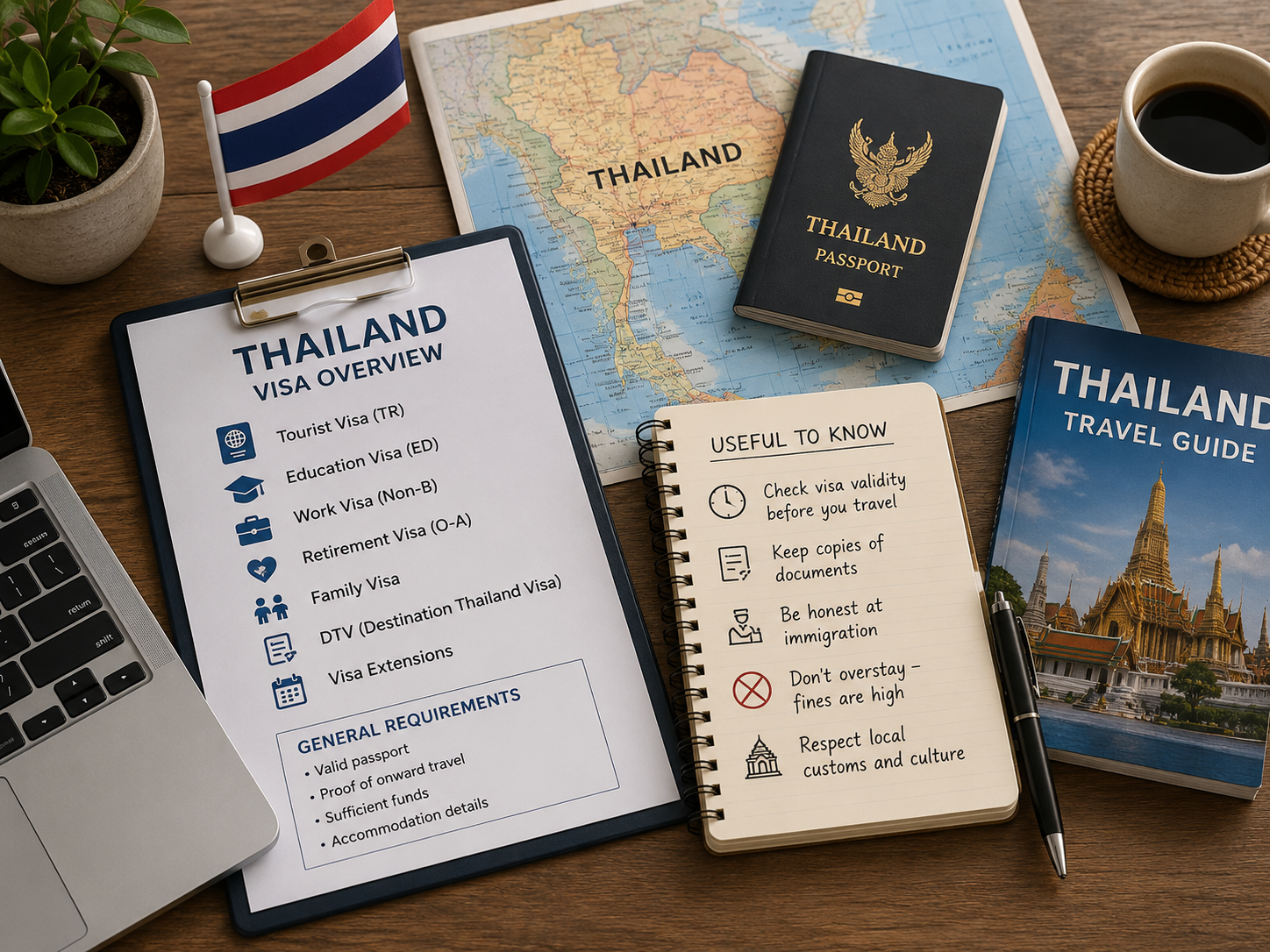
- Check visa rules before you fly; most nationalities get visa-exempt entry, but conditions change — verify with the Thai Immigration Bureau.
- Carry cash: markets, longtail boats and small cafés rarely take cards.
- Rent a scooter only with a valid motorcycle licence and helmet; fines and accidents are common without them.
- Respect marine-park rules and lifeguard flags; never swim past a red flag during the monsoon.
- Dress respectfully at temples and remove your shoes where required.
- Book high-season flights and hotels well ahead, especially over the New Year peak.
Sources: Tourism Authority of Thailand (tourismthailand.org); Airports of Thailand (airportthai.co.th) and Phuket International Airport (phuketairportthai.com); Department of National Parks, Wildlife and Plant Conservation (dnp.go.th); Thai Immigration Bureau (immigration.go.th).