Rawai, Phuket: Area & Beach Guide
The laid-back south — Rawai's beach, seafood, longtail piers and why long-stayers love it.
Updated 2026-08-04
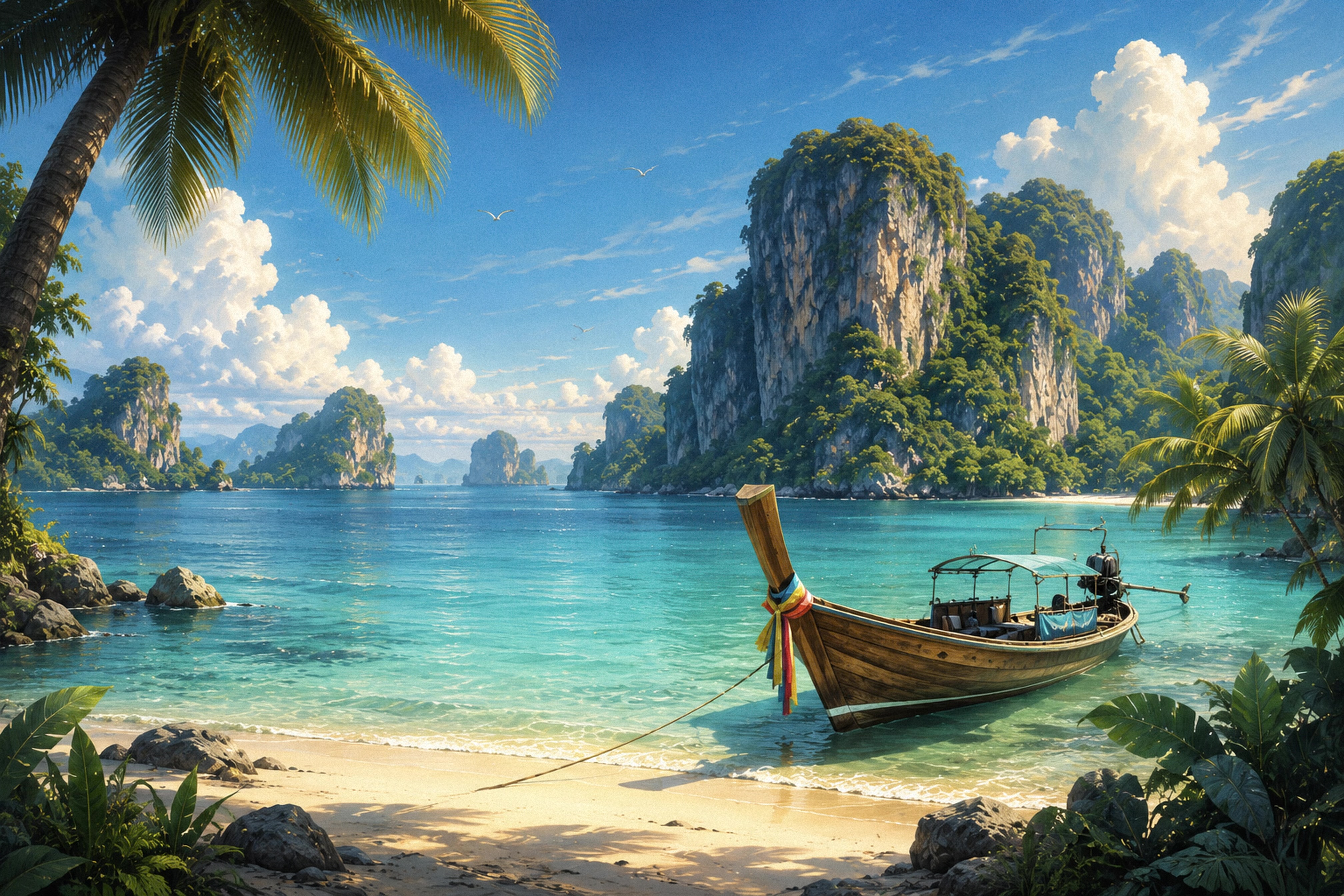
Rawai is a quiet district and beach on the southern tip of Phuket, known not for swimming — its shallow, rocky shore and moored longtail boats make that impractical — but for its fresh-seafood market, its sea-gypsy (Chao Le) community, and boat trips to nearby islands. Stay here for local life and cheap seafood, and head to neighbouring Nai Harn or Ya Nui when you want to swim.
History and location of Rawai
Rawai sits at the southern end of Phuket, bordering the Chalong sub-district and a short drive from Promthep Cape. It was one of the island's earliest settled coastal areas, long a home to the Chao Le (sea gypsies) and Thai fishing families before mass tourism reached the west coast. That history is why Rawai still feels more like a working Thai community than a resort strip — the fishing boats moored offshore are not decoration but livelihoods.
What Rawai beach looks like today
The beach itself is a long, curving bay with darker, coarse sand and a shallow, rocky bottom that empties out at low tide. Rows of longtail and speedboats line the shore, and the promenade behind holds seafood grills and cafés. It photographs well at sunset, but it is a place to stroll, eat and launch a boat rather than lay out a towel and swim.
Geography of the southern cape
Administratively Rawai is a tambon covering Phuket's south, wrapping from Chalong Bay around toward the Nai Harn area. Its position at the island's tip gives it easy sea access in several directions, which is exactly why it became a launch point for island trips — the sheltered nearby islands are all within a short boat ride.
Why Rawai is not for swimming — yet still worth it
Be honest with your expectations: Rawai is not a swimming beach. The water is shallow far out, the bottom is rocky and often littered with sea urchins, and boat traffic near the shore makes wading risky. Many first-time visitors feel a flash of disappointment. But that same setting is what preserved Rawai's authentic character — the seafood, the boats, the local life — and the real swimming beaches are only minutes away. Treat Rawai as a base and a launch pad, not a sunbathing spot, and it rewards you.
Attractions and things to do in Rawai
Rawai's appeal is a cluster of experiences you cannot easily get on the busy west coast: raw local flavour, sea culture, and quick access to quieter islands. These are the highlights, in the order most visitors enjoy them.
The Rawai seafood market
Rawai's fresh-seafood market is the district's star. Stalls sell the morning's catch — prawns, crab, snapper, squid, lobster — by weight, and the neighbouring restaurants will cook whatever you buy for a small per-dish fee. The routine is simple: haggle politely at the stalls, confirm the price per kilo before it is weighed, then carry your bag to a restaurant to be grilled or wok-fried. It is some of the best-value seafood on Phuket if you check the price at every step.
Boat trips from Rawai
Rawai and the adjoining Chalong area are Phuket's springboard for the southern islands. Longtails and speedboats run from the beach to Coral Island (Koh Hey), Racha Yai and Racha Noi, and Bon Island — all good for snorkelling and calmer, clearer water than the mainland shore. Negotiate directly with boat operators on the beach, agree the return time clearly, and travel in the morning for the flattest sea.
Culture and viewpoints
The Chao Le sea-gypsy village near the beach gives a rare glimpse of a centuries-old maritime culture, and a respectful, low-key visit is welcome. A few minutes away, Promthep Cape is Phuket's best-known sunset viewpoint, and the nearby Windmill Viewpoint and Ya Nui beach round out a southern loop you can drive in an afternoon.
- Graze the Rawai seafood market and have your catch cooked next door.
- Take a morning longtail to Coral Island or the Racha islands for snorkelling.
- Watch sunset from Promthep Cape, the southern tip of Phuket.
- Visit the Chao Le sea-gypsy village for a slice of local culture.
- Swim and snorkel at neighbouring Ya Nui, a tiny scenic cove.
Where to stay in Rawai
Rawai suits travellers who want value and local life over beachfront glamour. Accommodation ranges from budget guesthouses and pool villas rented long-term by digital nomads and winter residents, through mid-range boutique hotels, to a handful of upscale villas on the hillsides toward Nai Harn. Because Rawai is not a prime swimming beach, room rates tend to be lower than at Kata or Patong for comparable quality — an advantage for longer stays.
Restaurants and cafés in Rawai
Beyond the seafood market, Rawai has one of Phuket's most varied and affordable dining scenes. The seafront strip serves fresh grilled fish and Thai classics, while inland you will find excellent local som tam and curry shops, plus a surprising range of international cafés and vegetarian spots serving the long-stay community. Buy at the market and eat at a partner restaurant on the shore as the boats come in.
How to get to Rawai
Rawai lies about 45–55 km from Phuket International Airport in the north, roughly an hour by road. The simplest options are a metered airport taxi or a ride-hailing app such as Grab or the local Bolt; from other parts of the island, app taxis and scooters both work well. If you ride a scooter, carry a valid motorcycle licence and helmet — police checkpoints on the southern roads do issue fines.
- Airport taxi or transfer: the most direct route, about one hour.
- Ride-hailing apps (Grab, Bolt): convenient from anywhere on Phuket.
- Scooter: cheap and flexible, but only with a valid motorcycle licence.
The best time to visit Rawai
As across Phuket, the dry high season from November to April brings the calmest sea and the best conditions for the boat trips that make Rawai worth basing at. The green season, May to October, is cheaper and quieter but rougher at sea, and some island crossings are cancelled in bad weather. The seafood market runs year-round.
Rawai compared with nearby beaches
The fairest way to understand Rawai is against its swimming-friendly neighbours. Nai Harn, a short drive west, is a sheltered bay with clear, swimmable water and green surroundings — the beach many Rawai visitors head to for a proper swim. Ya Nui, between Rawai and Promthep Cape, is a small cove good for snorkelling. Together they pair well: eat and launch boats at Rawai, swim at Nai Harn or Ya Nui.
Is Rawai worth visiting?
Rawai is worth it for the right traveller. Come for local Thai atmosphere, good-value seafood, easy island access and a calmer, more residential base, and it delivers. Come expecting a postcard swimming beach and it will not. Pair it with Nai Harn and Ya Nui and you get both: local life and clean water within minutes of each other.
Sources: Tourism Authority of Thailand (tourismthailand.org); Marine Department of Thailand (md.go.th) for boat and marine safety; Airports of Thailand — Phuket International Airport (phuketairportthai.com).