Islands of Thailand for Travellers
A map-level guide to Thailand's islands by region, vibe and season.
Updated 2026-08-04
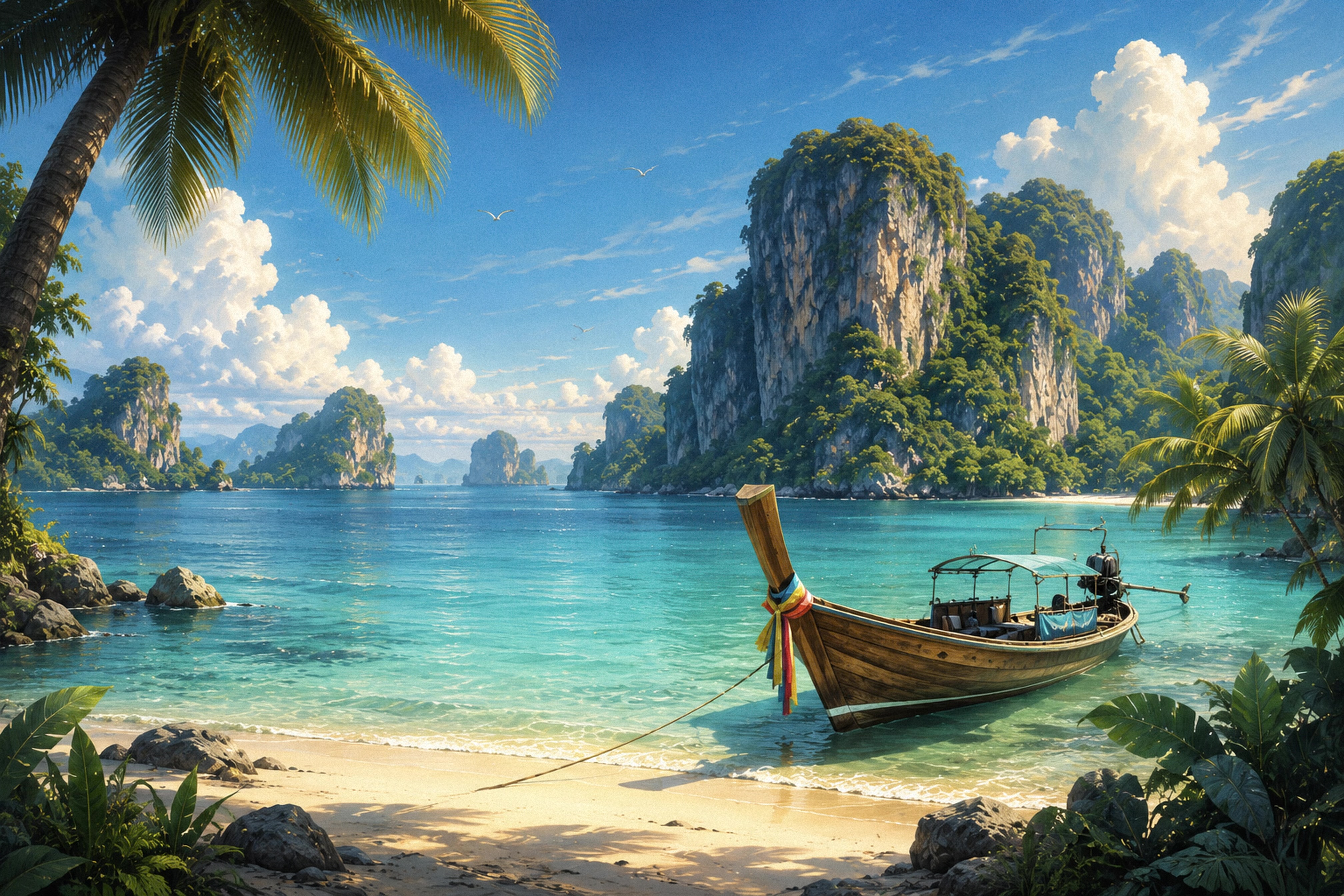
Thailand has hundreds of islands split between two seas: the Andaman Sea in the west (Phuket, Phi Phi, Krabi's islands, Koh Lanta, the Similans, Koh Lipe) and the Gulf of Thailand in the east (Koh Samui, Koh Phangan, Koh Tao, Koh Chang, Koh Kood). The single most important planning fact is that the two sides have opposite rainy seasons — the Andaman coast is best November to April, while the Gulf islands stay driest roughly December to August. Choose your island by the experience you want, then let the season decide the coast.
How Thailand's islands are divided geographically
Thailand's islands fall into two groups defined by the water around them. On the west lies the Andaman Sea, part of the Indian Ocean, holding Phuket, the Phi Phi islands, the islands off Krabi, Koh Lanta, the Similan Islands and, far to the south near the Malaysian border, Koh Lipe. On the east lies the Gulf of Thailand, holding Koh Samui, Koh Phangan and Koh Tao in the south, and Koh Chang and Koh Kood near the Cambodian border in the east. Understanding which sea an island sits in tells you almost everything about when to visit it.
Andaman Sea versus the Gulf of Thailand: the key differences
The two seas differ most in their monsoon timing. The Andaman coast has its dry, calm high season from November to April and its rough, rainy low season from May to October, peaking in September–October. The Gulf runs later: it stays comparatively dry from about December to August and takes its heaviest rain in October and November. In broad terms the Andaman side has more dramatic limestone scenery and the clearest dry-season water, while the Gulf has classic palm-fringed island atmosphere and works as an alternative when the west coast is wet.
Top islands of Thailand for a holiday
A handful of islands dominate Thai tourism, each with a distinct character. Below are the destinations most travellers choose.
Phuket — the largest island and tourism capital
Phuket, in the Andaman Sea, is Thailand's biggest island at 543 km² and its most developed resort. It has the widest choice of beaches on a single island — from lively Patong to family-friendly Karon and Kata and quiet Nai Harn and Nai Thon — plus the fullest infrastructure: its own international airport, hospitals, malls and every level of hotel. It is also the natural base for boat trips to Phang Nga Bay and the Phi Phi and Similan islands, and for sights like the Big Buddha and the Sino-Portuguese Old Town. Choose Phuket if you want beaches, nightlife, day trips and services all in one place.
Koh Samui — relaxed luxury in the Gulf
Koh Samui, in the Gulf off Surat Thani, has a more laid-back, palm-fringed island feel and a strong line-up of resorts. Chaweng is its liveliest beach and Lamai its calmer sibling, while dense inland jungle, waterfalls and temples such as the Big Buddha and Wat Plai Laem give it character. Samui has its own airport and is the gateway to the Ang Thong Marine Park. Because it follows the Gulf's weather calendar, it is a smart alternative when the Andaman coast is wet.
Phi Phi — natural beauty and famous beaches
The Phi Phi islands (Ko Phi Phi), between Phuket and Krabi in the Andaman Sea, are famous worldwide for the towering limestone cliffs and turquoise bays that featured in the film 'The Beach'. Phi Phi Don is the inhabited island with beaches and nightlife; Phi Phi Leh is uninhabited and holds Maya Bay, now managed with visitor limits to let its reef recover. The islands are reached by ferry from Phuket or Krabi. To enjoy them at their best, arrive early or stay overnight to see the bays after the day-trip boats leave.
Krabi's islands — the perfect balance
Krabi province, on the mainland Andaman coast, gives access to some of Thailand's most striking scenery and a cluster of easy island trips. The cliff-backed Railay peninsula, reachable only by boat, draws rock climbers from around the world, while the Hong and Poda islands make good kayaking and snorkelling day trips from Ao Nang. Krabi is quieter and more nature-focused than Phuket, yet close enough to pair with it in one Andaman itinerary.
Koh Chang — nature and adventure
Koh Chang, in the eastern Gulf near Cambodia and reachable from Bangkok or Pattaya by road and ferry, is Thailand's second-largest island. Much of it is mountainous jungle protected as a national park, with waterfalls, viewpoints and a still-developing tourism scene. Its west-coast beaches — White Sand Beach, Klong Prao and Lonely Beach — range from family-friendly to backpacker. Choose Koh Chang for jungle trekking, waterfalls, diving around the nearby islands, and a slower pace than the southern resorts.
Koh Phangan — parties and tropical nature
Koh Phangan, just north of Samui in the Gulf, is best known for the monthly Full Moon Party at Haad Rin, one of the world's biggest beach parties. But most of the island is quiet and green, with waterfalls, viewpoints, yoga retreats and peaceful bays like Thong Nai Pan. It is easily reached by ferry from Samui, making it simple to combine a lively night with days on calmer beaches.
Quieter, lesser-known islands
Beyond the headline names lie islands that are just as scenic but far less crowded.
Koh Lanta — calm and authentic
Koh Lanta, south of Krabi in the Andaman Sea, is a relaxed, family-friendly island with a string of long west-coast beaches, a laid-back old town and a national park at its southern tip. It is more low-key and better value than Phuket, reached by ferry or road bridge from Krabi, and is ideal for travellers who want quiet sand, sunsets and a slower rhythm.
Koh Lipe — clear water in the deep south
Koh Lipe, near the Malaysian border inside Tarutao National Marine Park, is often called Thailand's Maldives for its powder-white sand and crystal water. It is tiny, car-free and superb for snorkelling straight off the beach. Reaching it takes effort — a speedboat from Pak Bara pier or from Langkawi in Malaysia — but the clear water and unspoiled feel reward the journey.
Koh Tao — diving courses and easy reefs
Koh Tao, the smallest of the three southern Gulf islands, is Thailand's diving-course capital, turning out large numbers of newly certified divers thanks to easy reefs, warm water and low prices. Sairee Beach is its main strand, lined with dive schools. Even non-divers enjoy the snorkelling, coral and relaxed atmosphere. It is reached by ferry from Koh Samui or Chumphon on the mainland.
Choosing an island by interest
Grouping islands by what you want to do is the fastest way to narrow the choice.
Best islands for diving and snorkelling
For underwater experiences the standouts are the Similan Islands (the clearest Andaman reefs, dry-season only), Koh Tao (affordable courses and easy reefs), Koh Phi Phi (dramatic drop-offs and reef sharks) and Koh Lanta (access to Hin Daeng and Hin Muang dive sites). Coral reefs, good visibility and warm water make Thailand one of Asia's best-value diving regions; beginners are well served on Koh Tao, while experienced divers head for the Similans.
Best islands for seclusion and romance
For a honeymoon or a quiet retreat, look to Koh Kood in the eastern Gulf, with its barely developed white-sand bays and clear water; Koh Lanta's calmer southern beaches; and the resort-only coves of Koh Yao Noi in Phang Nga Bay, where you can watch the sun set over limestone karsts with almost no crowds. These islands trade nightlife for privacy, space and natural beauty.
Best islands for active and adventurous travellers
If you want to stay busy, Krabi's Railay has rock climbing on its limestone cliffs, Koh Chang has jungle treks and waterfalls, Phang Nga Bay is good for sea-cave kayaking, and Koh Tao adds free-diving and cliff-jumping to its diving scene. Many islands rent kayaks, paddleboards and scooters, and reputable operators run guided climbing, trekking and kayaking tours.
Practical tips for island travel in Thailand
Good island-hopping comes down to timing, transport and budgeting. Below are the essentials that make trips smoother.
Best time to visit different islands
Match the island to the season. Andaman islands (Phuket, Phi Phi, Lanta, the Similans) are best from November to April; the Similans close entirely during the monsoon, with exact dates set each year by the Department of National Parks. Gulf islands (Samui, Phangan, Koh Tao, Koh Chang) stay driest from about December to August and are wettest in October–November. Prices and crowds peak around Christmas, New Year and Chinese New Year, so travelling in the shoulder months can be both cheaper and quieter.
How to move between islands efficiently
Ferries and speedboats connect most islands, with hubs at Phuket and Krabi (Andaman) and Surat Thani and Koh Samui (Gulf). Domestic flights link Bangkok to Phuket, Krabi and Samui in about 80–90 minutes, and combined bus-and-ferry tickets reach the Gulf islands cheaply. Book high-season ferries a day ahead, allow buffer time for weather delays in shoulder months, and note that crossing between the Andaman and Gulf sides usually means routing back through the mainland rather than a direct boat.
Budget planning and money-saving tips
As of 2026, expect a rough spread: budget rooms from around ฿600–1,200 a night, comfortable mid-range hotels ฿1,500–3,500, and resorts well above that in peak weeks. A simple local meal runs about ฿60–150, a full-day island-hopping boat tour roughly ฿1,200–2,500, and a rented scooter ฿200–350 a day. Accommodation and food are cheapest on the smaller, less-developed islands and in each region's green season. Carry cash for boats, markets and small cafés, which rarely take cards.
The best island tours and day trips
The most rewarding day trips let you reach beaches and reefs that are hard to visit independently. From Phuket and Krabi, boat tours run to Phi Phi and Maya Bay, the James Bond Island in Phang Nga Bay, and the Similans in season. From Koh Samui, the Ang Thong Marine Park is the classic outing, with kayaking among emerald lagoons and limestone cliffs. When choosing a tour, favour smaller groups and early departures to beat the crowds, and check that operators follow marine-park rules on anchoring and reef protection.
Sources: Tourism Authority of Thailand (tourismthailand.org); Department of National Parks, Wildlife and Plant Conservation (dnp.go.th); Airports of Thailand (airportthai.co.th) and Phuket International Airport (phuketairportthai.com); Thai Immigration Bureau (immigration.go.th).