Phuket International Airport: Full Guide
Terminals, transfers, fast track and everything you need on arrival and departure.
Updated 2026-08-04
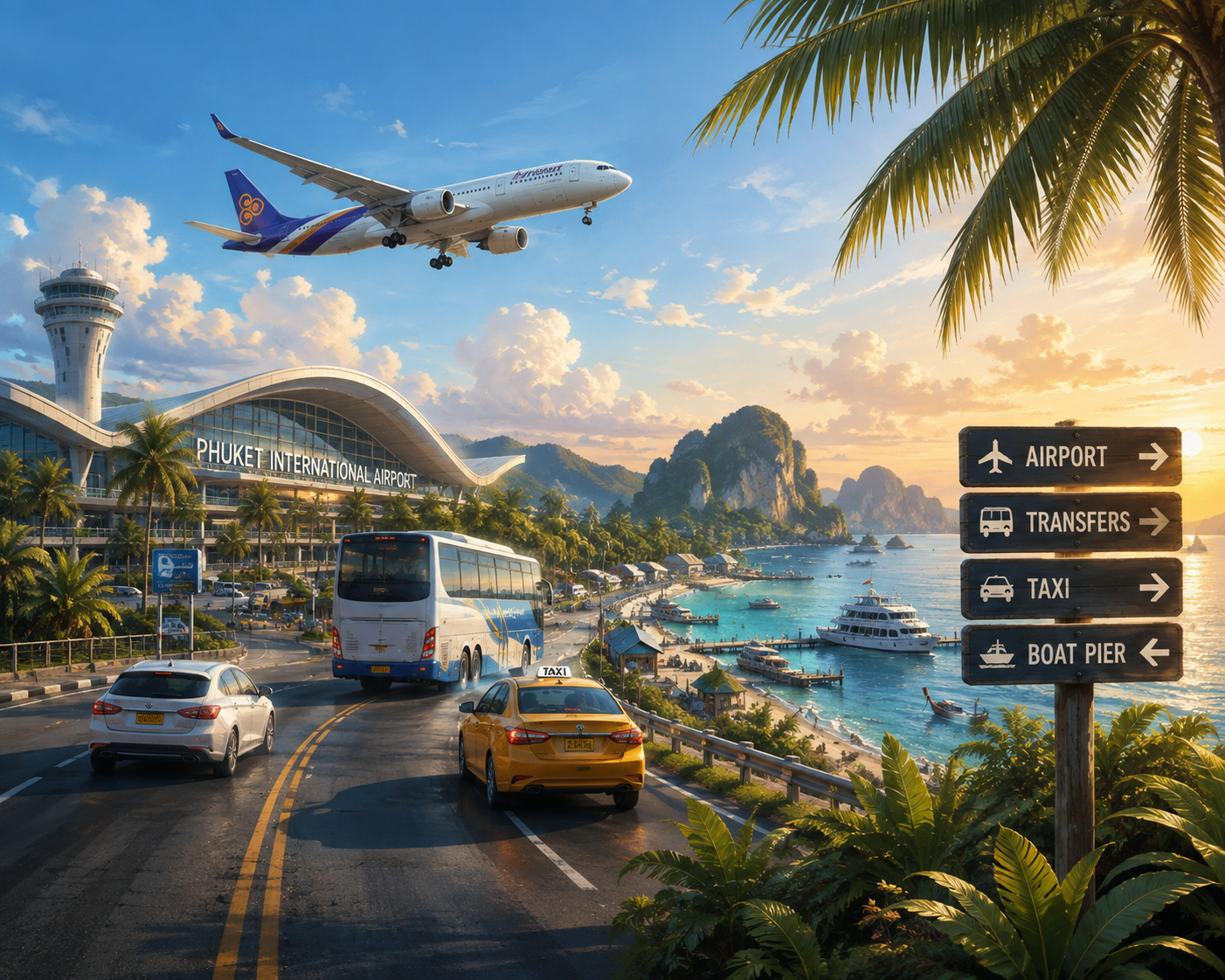
Phuket International Airport (IATA: HKT) is the gateway to the island, located in Sakhu, Thalang district, in the far north of Phuket near Mai Khao and Nai Yang beaches. Operated by Airports of Thailand (AOT), it handles both international and domestic flights and is one of Thailand's busiest airports. It has an international terminal, a domestic terminal and a charter terminal (Terminal X). It sits about 32 km from Phuket Town and 35 km from Patong, roughly an hour from most beaches by road; onward transfer options include official taxis, minibuses, the Phuket Smart Bus and rental cars.
General information about Phuket airport
Phuket International Airport, code HKT, is the second-busiest airport in Thailand after Bangkok and the main entry point for the Andaman coast. It lies at the northern tip of the island, so nearly every visitor passes through it and then transfers south to the beaches. The airport is managed by Airports of Thailand (AOT), the state operator that also runs Bangkok's Suvarnabhumi, and it serves a mix of scheduled international and domestic routes plus a heavy load of seasonal charter flights.
Location and contact
The airport is in the Sakhu sub-district of Thalang, in the far north of Phuket, right beside the coast — the runway runs almost parallel to Mai Khao and Nai Yang beaches. It sits about 32 km from Phuket Town and 35 km from Patong. For live flight information, official taxi fares and services, the airport's own website and the AOT flight boards are the authoritative source; verify details there rather than relying on third-party listings.
History and current state
The airport has grown steadily with Phuket's tourism, most notably through a major expansion that added the current international terminal and repurposed the older building for domestic flights. As of 2026 it operates as a modern two-main-terminal airport with a separate charter facility, handling long-haul, regional and domestic traffic year-round, with volumes peaking sharply in the November–April high season.
Capacity and statistics
Following expansion, Phuket airport's design capacity is on the order of 12–18 million passengers a year, and actual traffic regularly pushes against that ceiling in peak months. In practice this means arrivals and departures can be congested during high-season mornings and evenings, so allowing extra time — both to clear immigration on arrival and to check in on departure — is wise.
Airport structure and terminals
Phuket airport is compact and walkable, built around three parts: the international terminal, the domestic terminal and a charter terminal. Knowing which one you need before you arrive saves confusion, particularly on departure.
International terminal
The international terminal is the modern main building, handling all scheduled international arrivals and departures. Its layout is straightforward: departures and check-in are on the upper level, while arrivals — immigration, baggage reclaim and the exits to ground transport — are on the lower level. Signage is in Thai and English throughout, and the transfer desks, taxi counters and the Smart Bus stop are all reached from the arrivals level.
On arrival you descend from the aircraft to immigration, collect your bags in the reclaim hall, pass through customs, and emerge into the public arrivals area where transport counters wait. On departure you check in upstairs, clear security and passport control, then wait airside among the shops and cafés until boarding.
Domestic terminal
The domestic terminal handles internal Thai flights — to and from Bangkok (both Suvarnabhumi and Don Mueang), Chiang Mai and other cities. It is a short walk or shuttle from the international terminal. If you are connecting from an international arrival to a domestic flight, or vice versa, allow buffer time to move between the two buildings and re-clear check-in and security.
Terminal X for charter flights
A separate charter terminal, often referred to as Terminal X, handles seasonal charter traffic that spikes in high season. If you are travelling on a charter operator, check your ticket and confirm which terminal your flight uses, as it may differ from the scheduled international building.
Airport layout and navigation
Getting around inside is simple once you know the two-level logic — upper for departures, lower for arrivals — and that the terminals sit side by side. Follow the overhead signs (bilingual) toward immigration, baggage or ground transport. The main orientation points are the check-in rows and airline desks upstairs, the reclaim carousels and customs channels downstairs, and the marked transport counters just past the arrivals exit. When in doubt, information desks in each terminal can point you to the right gate or counter.
Flight boards and schedules
Live arrival and departure boards are posted throughout both terminals, and the airport publishes an online flight board so you can check status before leaving your hotel. The route mix is broad: scheduled international flights across Asia, the Middle East and Europe; heavy seasonal charter traffic in high season; and frequent domestic hops. Carriers you will commonly see include Thai Airways, Thai AirAsia, Bangkok Airways, Thai Lion Air, Nok Air and Thai Vietjet, alongside many international airlines. Always confirm your gate against the live board, as gates can change.
Going through the airport on arrival
Arriving international passengers follow a clear sequence: immigration, then baggage, then customs, then out to transport. Knowing the order — and having your paperwork ready — keeps the queue moving.
Passport control and immigration
After disembarking you reach immigration first. Have your passport ready and be prepared to show onward-travel and accommodation details if asked. Queues here are the main arrival bottleneck in high season, especially when several long-haul flights land together — patience and a filled-in arrival form (where required) speed things up.
Baggage claim
Past immigration, the baggage reclaim hall shows your flight and carousel on overhead screens. Trolleys are available free of charge. Check the screen for your carousel number and keep your baggage tag until you have left the hall, as it may be checked against your bags at the exit.
Customs
With your luggage, you pass through customs using the green channel (nothing to declare) or the red channel (goods to declare). Thailand sets duty-free allowances on alcohol, tobacco and goods; if you are over the limit or carrying restricted items, use the red channel. Once through, you enter the public arrivals area and the transport counters.
Services and facilities at the airport
Phuket airport covers the essentials for arriving and departing travellers, most of them concentrated in the international terminal.
Duty-free and shops
The airside departure area holds duty-free shops for perfume, alcohol, cosmetics and Thai souvenirs, plus convenience shops landside. Prices are fixed; buy liquids airside if you want to carry them onto the plane, subject to your onward country's rules.
Restaurants and cafés
Both terminals offer cafés, fast food and Thai-cuisine outlets, landside and airside. Prices are higher than in town, as at any airport, but you will find familiar chains alongside local Thai dishes. There are more options once you clear security in the international terminal.
ATMs and currency exchange
ATMs and licensed currency-exchange counters are available in the arrivals and departures areas. Airport exchange rates are usually poorer than in town, so change only what you need for the transfer and your first hours, then use bank ATMs or town exchanges for larger amounts. Thai ATMs charge a per-withdrawal fee for foreign cards, so withdraw a sensible lump sum at once.
Wi-Fi and internet
Free Wi-Fi is available throughout the terminals; connect via the airport network and follow the on-screen sign-in. For a local data SIM, provider counters in the arrivals area sell tourist SIMs with data packages — handy for ride-hailing apps and maps the moment you land.
Medical point and baggage storage
A first-aid / medical point is available for travellers who feel unwell. Left-luggage (baggage storage) counters let you store bags by the hour or day — useful on a late checkout or a long layover. Locations and prices are posted at the counters and on the airport website; expect a per-bag, per-day charge.
Transfers from Phuket airport
Because the airport is in the north and the resorts are spread down the west and south coasts, your transfer is a real part of the journey — budget roughly an hour to the main beaches. Four main options cover every budget, all arranged from the arrivals area.
Official taxis
Official airport taxis are booked at clearly marked counters in the arrivals hall, with set fares by destination zone — confirm the price before leaving the desk. As a rough guide, Patong runs around ฿800–1,000 and Phuket Town around ฿600–700 as of 2026. You pay at the counter and are matched with a driver at the rank outside; ride-hailing apps such as Grab are an alternative from the airport's signed pickup point.
Private transfers and limousines
For a hassle-free arrival — especially with family, lots of luggage or a late flight — a pre-booked private transfer or limousine gives a fixed price and a driver waiting with your name at arrivals. It costs more than a shared option but removes any negotiation or waiting.
Public transport
The Phuket Smart Bus is the budget-friendly public option, running from the airport down the west coast to Rawai and stopping at Surin, Kamala, Patong, Karon and Kata along the way. It is scheduled rather than on-demand, takes longer than a taxi, and costs roughly ฿100–170 depending on distance. Shared minibuses, booked at an arrivals counter for around ฿150–200, drop passengers hotel by hotel. For the specific times and costs to Patong, see our dedicated airport-to-Patong guide.
Car rental
Major rental companies have desks in the arrivals area. To rent and drive legally, you need a valid International Driving Permit alongside your home licence, a credit card for the deposit, and to be over the minimum age set by the company. Photograph the car's existing damage before driving off, and remember Thailand drives on the left.
Check-in and departure
On the way home, plan your timing around the season and terminal.
When to arrive at the airport
For international flights, arrive about 2.5–3 hours before departure, and closer to 3 hours in high season when queues at check-in and security lengthen. For domestic flights, 1.5–2 hours is usually enough. Building in a buffer matters here because peak-time congestion is the airport's main pain point.
Check-in desks and security
Check-in rows are on the upper (departures) level of the international terminal, grouped by airline — check the board for your row. After check-in you clear the security screening and then passport control before entering the airside departure lounges. Standard liquid and carry-on rules apply.
Waiting areas
Airside, the departure area has seating, shops, cafés and, for eligible passengers, lounges. Gates are a short walk from the main concourse; confirm your gate on the live board, as it can change, and keep an eye on the time during the busy evening departure wave.
VAT refund for tourists
Foreign visitors can reclaim the 7% VAT on qualifying goods bought at shops displaying the 'VAT Refund for Tourists' sign, subject to minimum-spend rules per shop and per trip. Ask the shop for the refund form (P.P.10) and keep the receipts. At the airport, before check-in, present the goods and forms at the Customs inspection point, then claim your refund at the VAT Refund counter after passport control, airside in the international departure area. Allow extra time for this if you are claiming.
Hotels near the airport
Because the beaches are an hour away, a night near the airport makes sense for early-morning departures or late-night arrivals. Several hotels and resorts cluster around Nai Yang and Mai Khao, minutes from the terminal, ranging from simple airport hotels to beachfront resorts. Many run their own free or paid shuttle to the terminal — confirm the transfer when you book so you are not left arranging a taxi at dawn.
Distances to popular beaches
The table below gives rough driving times and taxi costs from the airport to the main resort areas, as of 2026. Times assume normal traffic; the late-afternoon rush and the monsoon rains can add a fair margin, especially on the climb over Patong Hill.
Useful tips for travellers
A few habits smooth the airport experience at both ends of the trip.
Time-saving hacks
- Check the online flight board before leaving your hotel to catch delays early.
- Buy a tourist data SIM at arrivals so ride-hailing apps and maps work immediately.
- In high season, add an extra 30 minutes over the usual check-in guidance for queues.
- Pre-book your transfer so a driver is waiting rather than queuing at the taxi rank on arrival.
- If claiming VAT, get the Customs stamp before check-in — you cannot do it after security.
What to do near the airport
If you have hours to spare, two beaches sit right by the terminal. Mai Khao is Phuket's famous plane-spotting beach: aircraft pass low overhead on their final approach parallel to the sand — a spectacular sight, though standing directly under the flight path is discouraged for safety. Nai Yang, within Sirinat National Park, is a quiet, casuarina-shaded bay ideal for a swim and a seafood lunch before or after a flight.
Common mistakes to avoid
- Underestimating transfer time — the beaches are about an hour away, not next to the airport.
- Changing all your money at the airport, where rates are worst — change only what you need.
- Arriving too late for an international departure in high season, when queues are long.
- Going to the wrong terminal — confirm domestic vs. international vs. charter before you set off.
- Renting a scooter or car without the required International Driving Permit.