Dengue in Phuket: Symptoms & Prevention
How to recognise dengue, when to seek care and how to lower your risk.
Updated 2026-08-04
Dengue is a mosquito-borne viral fever that circulates on Phuket year-round and peaks in the rainy season (roughly May–October). It is spread by day-biting Aedes mosquitoes, not by contact between people. Most travellers who catch it recover in about a week with rest, fluids and paracetamol, but a minority develop severe dengue, which is a medical emergency — so knowing the warning signs matters.
What dengue is and how it spreads
Dengue fever is a viral infection caused by the dengue virus, a flavivirus with four distinct serotypes (DENV-1 to DENV-4). On Phuket and across Thailand it is transmitted by the bite of infected Aedes mosquitoes — mainly Aedes aegypti and Aedes albopictus. You cannot catch dengue directly from another person; the virus needs the mosquito as a go-between. The insect picks up the virus by biting an infected human, then passes it on days later to the next person it feeds on.
Classic dengue versus severe dengue
Most cases are classic dengue — a self-limiting fever that clears in about a week. A smaller share progress to severe dengue (formerly dengue haemorrhagic fever and dengue shock syndrome), marked by plasma leakage, bleeding and organ impairment. The risk of the severe form rises with a second infection by a different serotype, because prior antibodies can worsen the response. Even so, most repeat infections stay mild; the point is to watch for warning signs rather than to panic.
Dengue on Phuket: the current picture
Phuket is an endemic area, so a background level of dengue is present every year and is reported to Thailand's Department of Disease Control. Case numbers climb sharply after the rains begin, because puddles and water-filled containers give Aedes mosquitoes fresh breeding sites. Nationally, Thailand records tens of thousands of dengue cases in a typical year, with island and coastal provinces well represented. Treat any published tally as a snapshot: check the Ministry of Public Health for the latest figures before you travel.
Higher-risk zones and seasons
The clearest risk driver is the rainy season, roughly May to October, which overlaps Phuket's southwest monsoon. Risk tends to be higher in denser residential and semi-urban areas — Phuket Town, older neighbourhoods behind the beaches, construction sites and gardens with standing water — than on breezy, open beachfronts. Wherever there is untreated stagnant water near where you sleep, assume mosquitoes are breeding nearby.
Recognising the symptoms
Classic dengue usually starts abruptly, 4–10 days after the bite. The hallmark is a high fever (often 39–40°C) paired with a severe headache, pain behind the eyes, and deep muscle and joint aches — the old nickname "breakbone fever" captures how it feels. Many people also get nausea, a flushed face and a fine skin rash that appears a few days in. Because early dengue overlaps with flu, COVID and heat exhaustion, travellers often dismiss it. The distinguishing clues are the eye-socket pain, the intense bone-and-joint ache, and a fever that stays high rather than fluctuating.
When to get medical help
See a doctor to confirm the diagnosis with a blood test if a high fever lasts more than two days. Seek emergency care immediately if warning signs appear, especially as the fever starts to fall (days 3–7), when severe dengue can develop: severe abdominal pain, persistent vomiting, bleeding from the gums or nose, blood in vomit or stool, black stools, rapid breathing, cold clammy skin, restlessness or drowsiness. Phuket has international-standard hospitals in Phuket Town and near the main beaches; comprehensive travel insurance makes access straightforward.
How to protect yourself
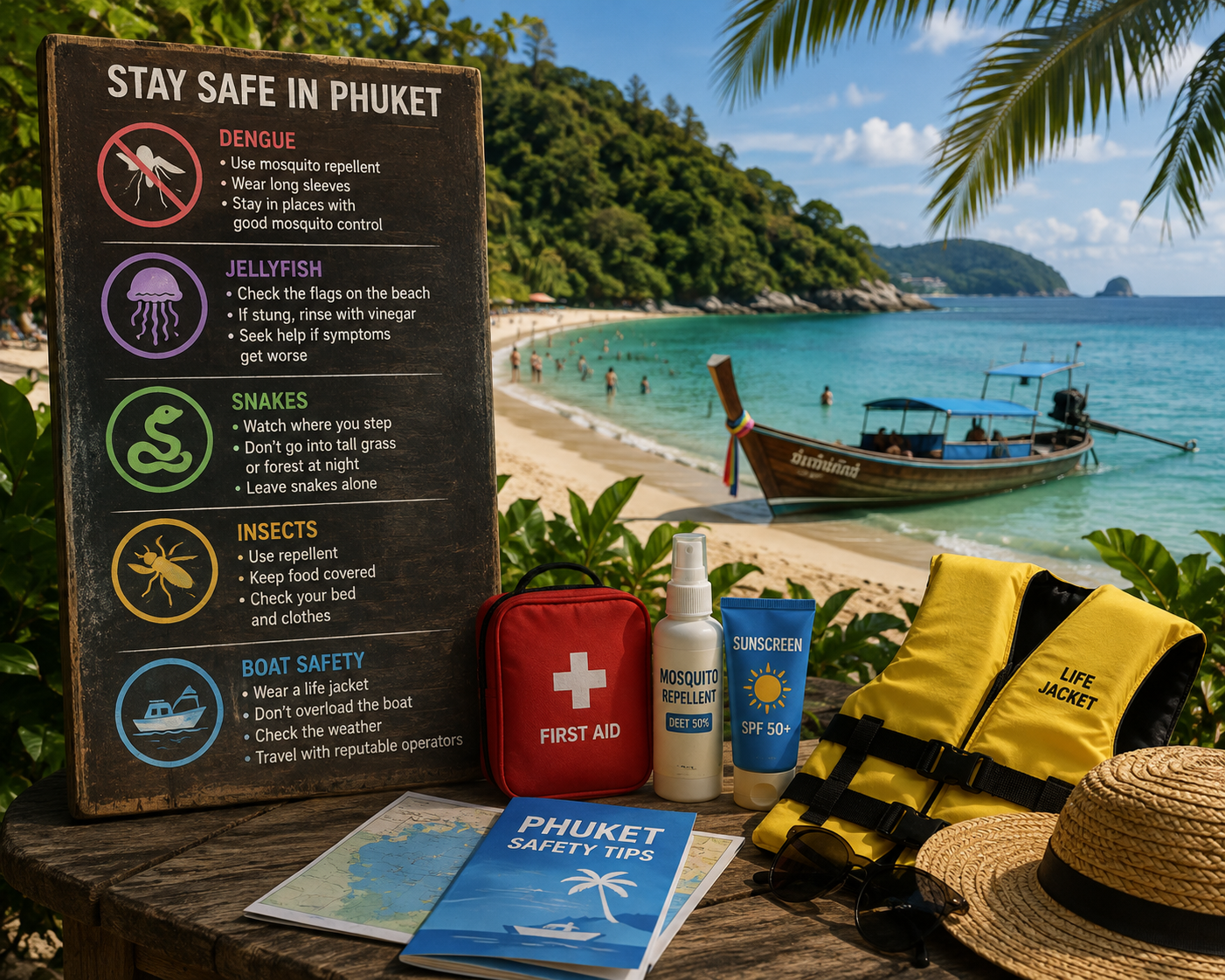
There is no everyday dengue vaccine for short-stay travellers, so bite prevention is the whole game. Because Aedes mosquitoes bite in daylight, protect yourself around the clock, not only in the evening.
- Apply repellent with DEET (20–30%), picaridin or oil of lemon eucalyptus to exposed skin, reapplying after swimming or sweating.
- Wear loose, light long sleeves and trousers when you are near gardens, greenery or standing water.
- Sleep in rooms with air-conditioning or intact screens, and use a plug-in vaporiser or a bed net if windows are open.
- Tip out or cover any standing water on your balcony or in the garden — plant trays, buckets, unused pots — to deny mosquitoes a nursery.
- Favour open, breezy beachfront accommodation over damp, enclosed spots hemmed in by vegetation.
Sources: Thailand Ministry of Public Health and Department of Disease Control (ddc.moph.go.th); Tourism Authority of Thailand (tourismthailand.org).