Snakes of Thailand: Which Are Dangerous
The snakes you might meet, which are venomous and how to react safely.
Updated 2026-08-04
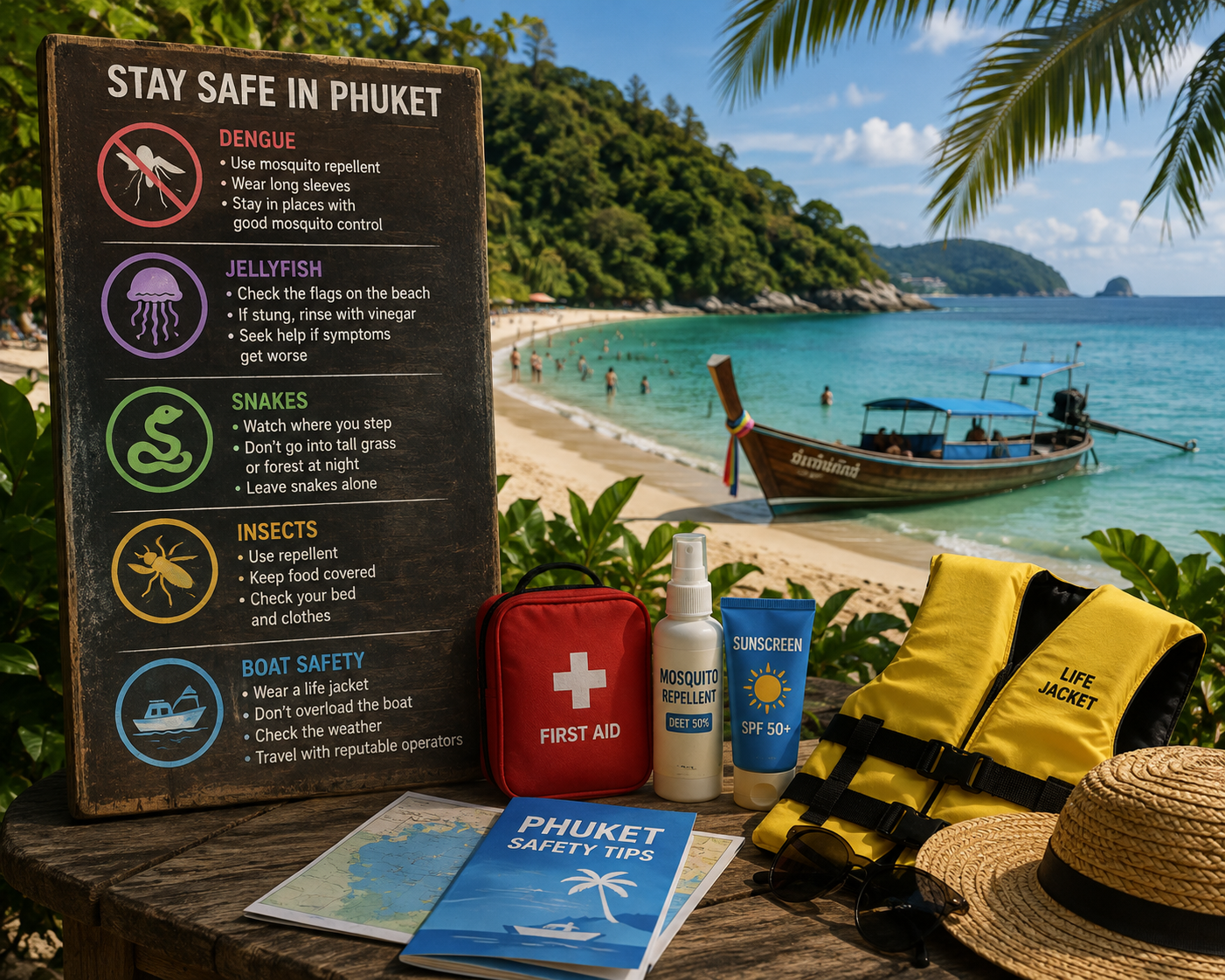
Thailand has well over 200 snake species, of which about 60 are venomous, but only a handful threaten people — chiefly cobras, kraits and a few vipers. Most snakes you might see, including on Phuket, are harmless and flee from humans. Serious bites are uncommon among tourists, and Thailand produces its own antivenoms. The practical goal: give any snake space and know what to do if a bite happens.
How widespread snakes are in Thailand
Thailand records more than 200 snake species, about 60 of them venomous — one of Southeast Asia's highest counts. Climate and habitat explain it: year-round warmth, high humidity and extensive tropical forest let cold-blooded reptiles stay active most of the year. Snakes are most visible in the warm, wet months, when rain pushes them to move and hunt frogs and rodents. National parks, from mainland rainforests to island reserves, hold the most species, but snakes also live in farmland, plantations and the edges of towns.
Where you might actually meet a snake
You are far more likely to meet a snake where wild and built-up land meet than deep in the jungle. Common spots: forest trails, overgrown village edges, resort gardens, drainage canals and ditches, rockeries, and sometimes houses that back onto greenery. On Phuket, a heavily touristed island, snakes turn up in residential and resort areas, especially properties bordering hills or scrub. Beaches rarely host land snakes, though sea snakes live in coastal waters. Snakes are far less common inside busy tourist zones than in rural areas, but the risk is never zero.
- Forest and national-park trails, especially at dawn and dusk.
- Resort and villa gardens, ponds and compost corners.
- Storm drains, ditches and canals that hold water.
- House interiors near gardens — bathrooms, garages, gaps under doors.
- Rocky shorelines and shallow water, where sea snakes may swim.
How to tell a venomous snake from a harmless one
There are rough visual guides, but none is reliable, so treat every unidentified snake as dangerous. Popular "rules" — a triangular head, slit pupils, bright warning colours — hold for some species and fail for others. Vipers such as the Malayan pit viper do have broad, arrow-shaped heads and vertical pupils. But cobras and kraits are elapids with rounded heads and round pupils, and rank among the country's most dangerous snakes. Some harmless species even mimic cobras by flattening their necks. Colour is no guide either: the deadly Malayan krait is a plain black-and-white banded snake.
The most dangerous venomous snakes of Thailand
A small number of species account for the medically important bites, and they fall into two broad venom categories. Neurotoxic venom (which attacks the nervous system and can stop breathing) comes mainly from the elapids: the monocled cobra (Naja kaouthia), the king cobra (Ophiophagus hannah) — the world's longest venomous snake — and the kraits, especially the Malayan or blue krait (Bungarus candidus), whose bite can be painless yet life-threatening. Haemotoxic venom (which damages blood and tissue) comes from vipers: Russell's viper (Daboia siamensis), the Malayan pit viper (Calloselasma rhodostoma) and the green pit vipers (Trimeresurus species). A few, like some cobras and Russell's viper, produce combined effects. Sea snakes are highly venomous but shy and very rarely bite swimmers.
What to do if you meet a snake
Snakes are not aggressive without provocation — almost every bite happens when one is stepped on, cornered or handled. If you see a snake, stop, stay still for a moment, then back away slowly and give it a clear escape route. A snake that is not trapped will almost always leave on its own.
- 1Freeze, then retreat
Stop moving, keep several metres of distance, and step back slowly rather than turning and running blindly.
- 2Give it room
Do not block its path. Let the snake slither away; it wants to escape as much as you do.
- 3Keep others clear
Move children and pets away and warn people nearby, especially on a trail or in a garden.
- 4Call for removal
If a snake is inside a home or resort, do not tackle it. Thailand's rescue services (dial 191 or 199) and local snake-catchers relocate them safely.
First aid for a snakebite
A snakebite is a medical emergency: the only definitive treatment is antivenom given in hospital, and Thailand manufactures its own through the Queen Saovabha Memorial Institute of the Thai Red Cross. The priority is to get the person to a hospital quickly and calmly while keeping the bitten limb as still as possible. Call 1669 for a Thai ambulance, or head straight to the nearest hospital.
- Keep the person calm and as still as possible; movement speeds venom spread.
- Immobilise the bitten limb with a splint and keep it roughly at heart level.
- Remove rings, watches and tight clothing before swelling starts.
- Note the time of the bite and, if safe, photograph the snake from a distance.
- Get to a hospital immediately and let doctors choose the right antivenom.
Sources: Queen Saovabha Memorial Institute, Thai Red Cross Society (saovabha.redcross.or.th); Thailand Ministry of Public Health; Department of National Parks, Wildlife and Plant Conservation (dnp.go.th); Tourism Authority of Thailand (tourismthailand.org).