Flights to Thailand: All the Options
Hubs, connections and tips for finding a good fare into Thailand.
Updated 2026-08-04

Flying is the practical way into Thailand, and the cheapest fares almost always come from a big hub city on a one-stop route, booked on flexible dates a couple of months ahead. Bangkok (BKK/DMK) has the most flights and the lowest fares; Phuket, Krabi, Samui and Chiang Mai let you skip a domestic hop to your resort. Below is how to choose the right route, find cheap tickets, and reach the main resorts of Bangkok, Pattaya, Phuket, Samui and Krabi.
Main ways to fly to Thailand
There are two realistic ways to fly to Thailand: a non-stop flight, or a one-stop connection through an airline hub. Non-stop is fastest and most comfortable but usually the most expensive and available from fewer cities. A connecting flight adds a few hours but is typically cheaper and can be booked from almost anywhere, because the world's big hubs feed dozens of daily flights into Bangkok and the resort airports. For most travellers, the connecting route wins on price and choice.
Direct flights: the simplest option
If your city has a non-stop service, it is the easiest way to go — one boarding, no layover, luggage checked straight through. Bangkok has by far the widest choice of direct long-haul flights, operated by Thai Airways and many international carriers. Phuket and, seasonally, Krabi also receive some non-stop and charter services, mainly in the November–April high season. When comparing, weigh the premium for a direct flight against the money you would save on a connection.
Connecting flights and the best transit hubs
A one-stop routing is where most travellers save money. The trick is choosing an efficient hub with reliable, well-timed onward flights. Gulf hubs — Doha, Dubai and Abu Dhabi — are excellent for travellers from Europe and Africa. Asian hubs — Singapore, Kuala Lumpur, Hong Kong, Seoul, Taipei and Bangkok itself — have the deepest networks within Asia and cheap onward hops. Singapore and Kuala Lumpur are particularly convenient because budget carriers connect them directly to Phuket, Krabi and Samui.
How to save on connecting flights
- Book the entire trip on one ticket so bags are through-checked and connections protected.
- Pick a hub with a comfortable but not excessive layover.
- Check whether the connecting country needs a transit visa.
- Watch baggage allowances if any leg is on a low-cost carrier.
- Compare the total door-to-door time and price, not just the cheapest headline fare.
Charter flights and package deals
In high season, charter flights and tour-operator packages can be among the cheapest ways to reach Thai resorts, sometimes flying direct to Phuket or Krabi from markets with no scheduled non-stop service. A flight-plus-hotel package priced as a bundle can beat booking the parts separately. The downsides are rigidity — fixed dates, tight baggage limits and less recourse if plans change — so always compare the all-in package price against independent bookings before committing.
How to find cheap flights to Thailand
The price you pay depends more on when and how you book than on luck. Fares are highest in the December–January peak and around Thai holidays, and lowest in the shoulder months. Flying from a large hub city is almost always cheaper than from a small regional airport, so it is often worth a short positioning flight or drive to a bigger departure point. Use a multi-airline comparison search, look at a whole month at once, and let flexible dates guide you to the cheapest days.
A simple booking strategy
- 1Set your window2–3 months out
Start looking a couple of months ahead. Prices for the December–January peak climb early, so book those dates sooner.
- 2Search flexibly
Use a flexible-date, whole-month view on a multi-airline comparison tool to spot the cheapest departure and return days.
- 3Compare departure cities
Check fares from more than one nearby airport; a larger hub city is often noticeably cheaper for the same journey.
- 4Weigh direct vs one-stop
Compare the total price and total travel time of a non-stop flight against a one-stop connection before deciding.
- 5Book and lock the details
Once the price is right, book on a single ticket, then confirm baggage, seats and any transit-visa needs.
Reaching Thailand's main resorts
Where you fly into depends on your final destination. Bangkok is the hub for the capital and central Thailand; the Andaman coast is served by Phuket and Krabi; and the Gulf islands by Ko Samui or Surat Thani. Flying into the airport nearest your resort saves a long onward transfer, but the nearest airport sometimes has pricier or fewer flights — so it can be cheaper to fly to Bangkok and add a domestic hop.
Bangkok
Bangkok has the most flights and generally the lowest fares of any Thai gateway, making it the default entry point. From Suvarnabhumi, the Airport Rail Link and metered taxis reach the city centre; Don Mueang is the low-cost hub and handy for onward domestic flights. Even if your goal is a beach, routing through Bangkok can be the cheapest overall itinerary.
Pattaya
The nearest coastal resort to Bangkok, Pattaya is usually reached by flying into Suvarnabhumi and taking a bus or private transfer of about 1.5–2 hours. U-Tapao (UTP) airport is closer to Pattaya and takes some regional and seasonal flights, but Bangkok has far more choice.
Phuket
Phuket International Airport (HKT) takes long-haul, regional and charter flights, so many visitors reach the island without touching Bangkok. From the airport, the airport bus, metered taxis, ride-hailing apps and pre-booked hotel transfers all serve the beaches. Phuket is also the springboard for Phi Phi and Krabi by ferry or speedboat.
Ko Samui and Krabi
Ko Samui has its own airport (USM) with regional flights; a cheaper alternative is to fly to Surat Thani (URT) and take the well-organised bus-and-ferry combination. Krabi International Airport (KBV) is the gateway to Ao Nang and Railay, a short taxi or transfer away, and to the islands of the southern Andaman coast.
From the airport to your accommodation
After landing, use official transport for the final leg: metered taxis from the sanctioned rank, airport buses, rail links where available, or a pre-booked transfer. Avoid drivers touting inside the terminal, and either confirm the meter is running or agree the fare before you set off. If you land late or are heading to an island, arrange the onward transfer in advance, as options thin out in the evening.
Before you fly: documents and entry
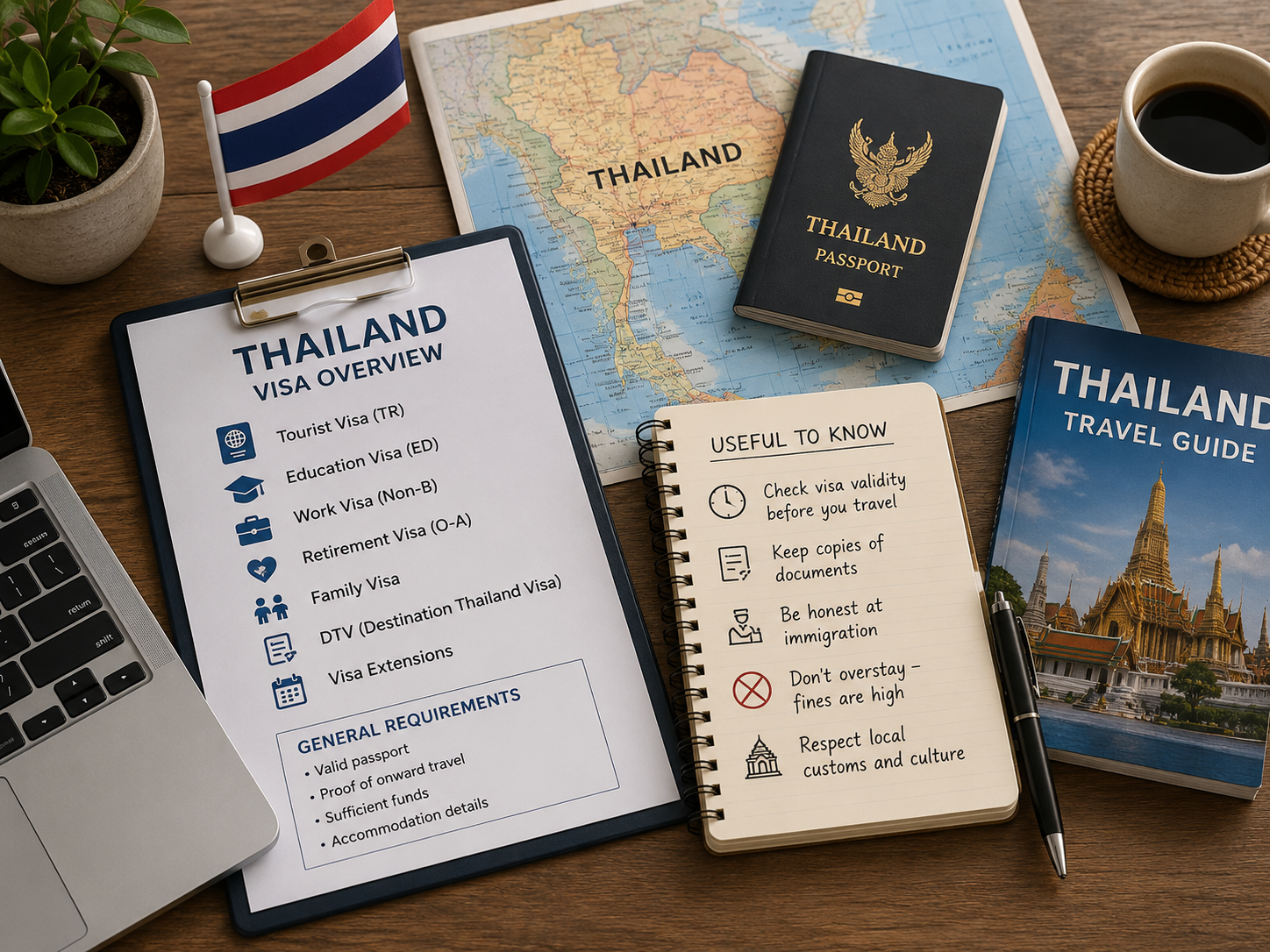
Check that your passport is valid for at least six months beyond your arrival date, and confirm whether you need a visa or qualify for visa-exempt entry — rules vary by nationality and change over time, so verify your status with the Thai Immigration Bureau before booking. Travel insurance is strongly advised, and keeping digital and printed copies of your tickets, hotel and any onward transfers makes arrival smoother.
Sources: Tourism Authority of Thailand (tourismthailand.org); Airports of Thailand (airportthai.co.th) and Phuket Airport (phuketairportthai.com); Thai Immigration Bureau (immigration.go.th) for entry and visa requirements.